
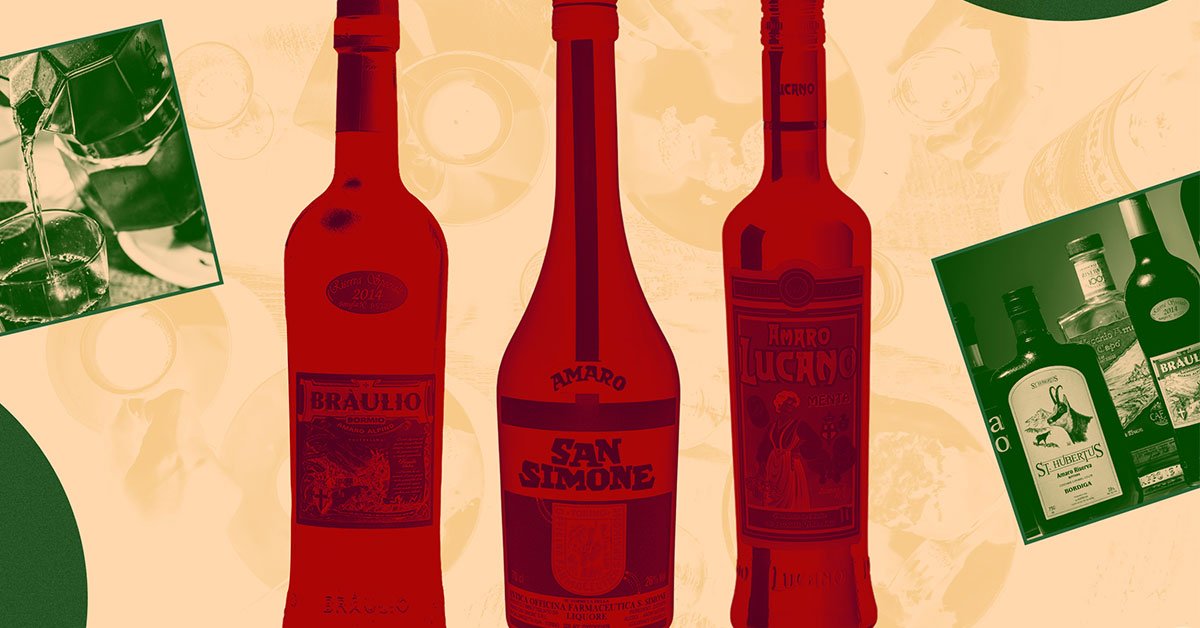

Not to sound too wistful, but these days, it’s easy to forget how modest the amaro options in the U.S. once were. Now, most backbars are lined with a wide and rich spectrum of amaro and European liqueurs, but that was not the case when, as a burgeoning drinks writer in the mid-2000s, I first spiraled down the bitter rabbit hole.
Perhaps that’s why, when in Italy, my biggest thrill still comes from acquiring “suitcase bottles” of amaro, those deep-cut discoveries that range from limited-run riservas to special-edition releases, distillery gift shop exclusives (like Amaro Lucano Menta), dusty vintage finds, and yet-to-be imported brands.
At Popina, a modern Italian restaurant on the Brooklyn waterfront, owner and general manager James O’Brien shares a similar affinity for suitcase bottles. When visiting wine producers in Italy, he always makes room for a few special bottles, whether it’s a rare wine, an amaro that you can’t find stateside or a bottle of vintage Chartreuse. O’Brien views it as a way to surprise and delight guests. “The suitcase haul has always been one of my favorite tricks because it feels the most personal,” he says. Offering guests pours from hard-to-source bottles “lets them feel like they tagged along on your trip.”
The bottles in my amari collection that have made the transatlantic journey home do possess a transportive quality. Often, it was the “hunt” to secure these bottles that makes them special. Now, though, some formerly elusive brands and expressions have become available stateside. Does a suitcase bottle risk losing its allure when it attains dual citizenship?
Among the many only-in-Italy bottles I typically bring home with me, Bràulio Riserva, the annual limited-run release of the iconic alpino-style liqueur, remains my first love. Less filtered and aged in smaller barrels for up to 24 months, it’s achieved a bit of a cult-like appeal among amaro heads, and its dated annual releases makes it ideal for vertical flights and tastings. I used to be able to find it for around 22 euros a bottle, though that’s since gone up to around 33 euros to 45.
There were whispers for years that Bràulio Riserva, part of the Gruppo Campari portfolio, would eventually make its way to the U.S., and sure enough, this past holiday season, I finally spied the amaro at my local bottle shop in Brooklyn. But my brief moment of joy was deflated when I saw it was priced at $82. This is in line with the list price of other Italian riserva releases, but the sticker shock made me balk. I left the Bràulio Riserva on the shelf.
As O’Brien explains, “being considered more rare, riservas can probably afford to be less price-sensitive. But when they’re new to the U.S. market they have the opportunity to see where they want to fall: approachable or luxury?”
Taylor Mason, a fellow suitcase amaro fan, suspects the word “riserva” is being used to justify higher costs in the U.S. Mason is the chef and co-owner of Luca and Pizzeria Luca in Lancaster, Pennsylvania, and he curates a small but growing vintage amari selection at his restaurants. He also helps lead food tours throughout Italy. “While advocates like us will always be singing their praises regardless of the cost, inflated pricing is unfortunate and hard to be looked at as anything other than price gouging,” he says. Others, like Patrick Miller, founder and co-owner of Brooklyn’s Faccia Brutto Spirits, attribute rising costs to tariff surcharges. “There’s a point where brands have to look at the rising cost of doing business and say, ‘Do we pass this on to the customer or not?’” he says.
For the Bràulio, the bottle does seem to be appealing to at least some stateside shoppers: Brooklyn Wine Exchange in Cobble Hill says that, since the amaro arrived in mid-December, it has sold almost two cases. Much of that, however, can be attributed to the knowledgeable staff hand-selling the product.
“We are not diluting its charm but offering more people the chance to experience it.”
Aside from costs, another factor that’s shifting is scarcity. Amaro San Simone, the humble, family-owned “pride of Turin,” has been experiencing a bit of a glow-up, transforming from a regional curiosity to a word-of-mouth, in-demand suitcase bottle. For years, San Simone was only found within Turin and Piedmont, and its limited availability was part of its charm. The amaro built generations of loyal supporters without any advertising or marketing.
In recent years, though, San Simone has expanded across more regions in Italy, and Federico Fulcheri, the third-generation grandson of the founder, has been testing the waters bringing San Simone to a wider audience, slowly exporting internationally.
Last year, I shared the news that San Simone would finally be available in the U.S. in my newsletter, LAST CALL. Bottles were originally scheduled for December of last year, and are expected to arrive very soon. I asked Fulcheri if making San Simone more easily available might affect its appeal. “Its allure has never been based solely on scarcity, but on authenticity, history and flavor,” he said. “Expanding internationally does not diminish that—it enhances it. We are not diluting its charm but offering more people the chance to experience it.”
Personally, I’ll admit that scooping up a half-dozen bottles at an Italian supermercato for 12-16 euros a bottle—compared to its likely $35-$45 U.S. retail price—was in fact part of its charm. But I’ve been rationing the contents of the sole bottle in my possession, and I’ll be among the first to stock up when San Simone finally arrives stateside. I’ll do my best to resist being that guy who prides himself on seeing R.E.M. at a small Athens club back in the day before they blew up. Even with a higher price tag, picking up a bottle of San Simone at my local Brooklyn bottle shop will always be easier, and much less expensive, than booking a flight to Italy.
Still, with new arrivals comes the risk of bottles getting lost in translation. “Their success squarely rests on two things: wine shops and bars and restaurants educating customers about the brand, and the producer coming to the States for market work and continued education,” says Miller. As a producer himself, he says “there are only upsides. We have more variety, despite the higher-than-in-Italy cost, and who hates that?”
Plus, there will always be more underrated bottles to uncover. Popina’s O’Brien says, “It’s our job as beverage professionals to find that next special thing.” Future suitcase bottles candidates, for example, include Amaro Dente Di Leone La Valdotaine from Val d’Aosta, which was briefly imported to the U.S. and still has amaro fans craving more.
Chef Mason, meanwhile, is taking a “bottle half-full” outlook. “Italy is a seemingly evergreen source of amari, and tracking down new and enticing bottles will always be a thrill,” he says. He’s always on the lookout for distinct bottlings that “express micro-regional terroir,” like Frack Amaro Serale, a small-batch release from Vecchio Magazzino Doganale in Calabria, and Amaro Tattico, a light but nuanced expression from the north in Bassano del Grappa. “While I love the classics and having more availability in the U.S., I am continually more interested in smaller distilleries who are doing cool things, and I hope this opens the door for new bottles, new producers and new experiences. I’d be good with that.”