

It’s mid-fall — the leaves are turning, the air is crisp, and that unmistakable nutty aroma is back in the air. Yes, it’s walnut season!
Few foods feel as seasonal, satisfying, and versatile as walnuts. They’re sprinkled on cakes and cookies, folded into salads, ground into sauces, and even used to thicken savory stews. They’re rich in omega-3s, good fats, and antioxidants — and whether you’re cracking them by the fire or tossing them into your pasta, they’re one of the world’s most nutritious autumn treats.
Where the World’s Walnuts Come From
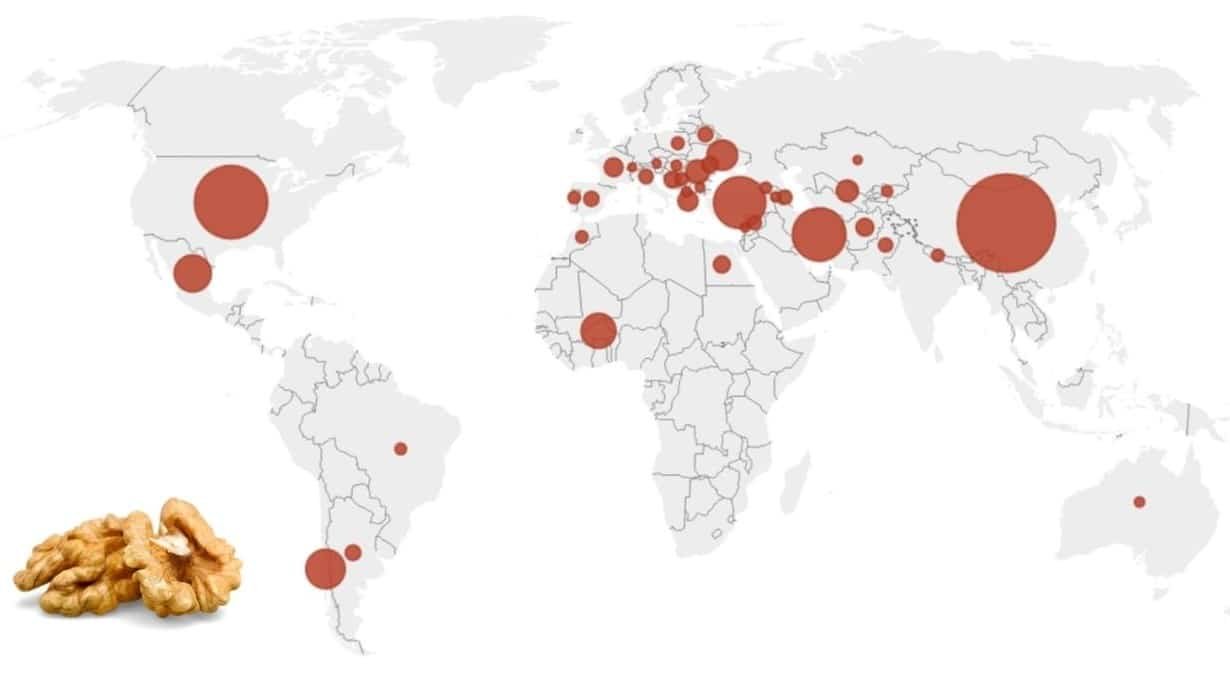
According to Chef’s Pencil’s analysis of the latest available FAO.org’s agricultural data, global walnut production is dominated by a few big players — with China, the U.S., and Iran leading the pack. Together, these three countries account for more than half of the world’s walnuts.
China is in a league of its own, producing a massive 1.4 million tonnes of walnuts last year — nearly double the output of the United States (748,000 tonnes) and almost four times that of Iran (381,000 tonnes).
Türkiye follows closely, with 360,000 tonnes, while Chile has rapidly climbed into fifth place at 192,000 tonnes — an impressive feat for a country that barely registered in global rankings two decades ago.
Further down the list, you’ll find Mexico, Burkina Faso, Ukraine, Romania, and Uzbekistan, rounding out the top ten. Europe still contributes significantly, with Greece, France, and Moldova remaining traditional walnut-growing regions, in addition to Ukraine and Romania.
Asia completely dominates global walnut production, led by China, which alone accounts for roughly half of the world’s total harvest at 1.4 million tons. Other key producers include Iran, Türkiye, Uzbekistan, and Afghanistan, all benefiting from ideal climates for walnut cultivation. Many Central and West Asian countries—like Azerbaijan, Pakistan, and Nepal—also contribute meaningfully to the region’s growing output, highlighting Asia’s long tradition of walnut farming and its continuing expansion thanks to improved varieties and farming practices.
Europe (excluding Türkiye) contributes a smaller share to global walnut production but boasts some of the world’s highest yields per hectare. Romania, Austria, and Bosnia consistently report the highest yields globally. Leading European producers include Ukraine, Romania, France, Greece, Bosnia and Herzegovina, and Moldova.

The Fastest-Growing Walnut Producers
When you look at growth rather than size, a fascinating picture emerges. Over the past 20 years, walnut cultivation has exploded in some unexpected places.
Chile takes the crown for the most spectacular rise — up an astonishing 2,057% since 2003. Once a niche producer, Chile has become a Southern Hemisphere walnut powerhouse, exporting across the Americas and Europe.
Bosnia and Herzegovina also stands out, with growth exceeding 1,400%, reflecting how the Balkans are quietly reclaiming their old walnut traditions after decades of agricultural decline.
In Central Asia, countries like Uzbekistan (+234%) and Afghanistan (+592%) have seen remarkable expansion, driven by favorable climates and renewed investment in export crops.
Even the big players keep growing: China’s production rose 256% in two decades, while the United States grew by 153%.
The only real drop among the major producers? Egypt, where walnut production fell slightly by 8% — likely due to shifting agricultural priorities and climate pressures.


China’s Expanding Walnut Empire
China’s dominance in walnut production isn’t just about volume — it’s also a story of massive agricultural expansion and efficiency.
Between 2003 and 2023, China’s cultivated walnut area ballooned from 180,000 hectares to over 355,000 hectares, nearly doubling in just two decades. In addition to this, over the same period, yields per hectare jumped from 2,186 kg/ha to 3,932 kg/ha, reflecting better orchard management, modern irrigation systems, and improved walnut varieties.
In other words, China production increase has come not only by growing more walnuts but also growing them smarter — combining traditional farming with research-driven innovation to meet both domestic demand and growing export markets.
The Many Lives of a Walnut
Beyond the data, walnuts are pure culinary magic. They’re the foundation of Georgian satsivi, a luscious chicken-and-walnut sauce, or Greek walnut skordalia sauce; they add crunch and depth to Italian pesto alla genovese (yes, you can use walnuts instead of pine nuts) or pasta; and they bring richness to Persian fesenjan, a pomegranate-walnut stew that’s equal parts sweet, sour, and savory.
For dessert lovers, walnuts are the star of Greek baklava, Hungarian beigli, and Romanian cozonac — traditional holiday bakes that make the most of their earthy, buttery flavor.
If you want to try something healthy and satisfying, check out Chef Giorgos Tsoulis’s Mediterranean Chickpea & Eggplant Casserole — a hearty plant-based dish where toasted walnuts make the perfect garnish.
The Bottom Line
Walnuts are more than just a pantry staple — they’re a global crop connecting farmers in California, pickers in Central Asia, and bakers in Europe. Whether you enjoy them raw, roasted, or folded into a warm slice of cake, now’s the perfect time to celebrate the humble walnut — one of autumn’s greatest gifts.