
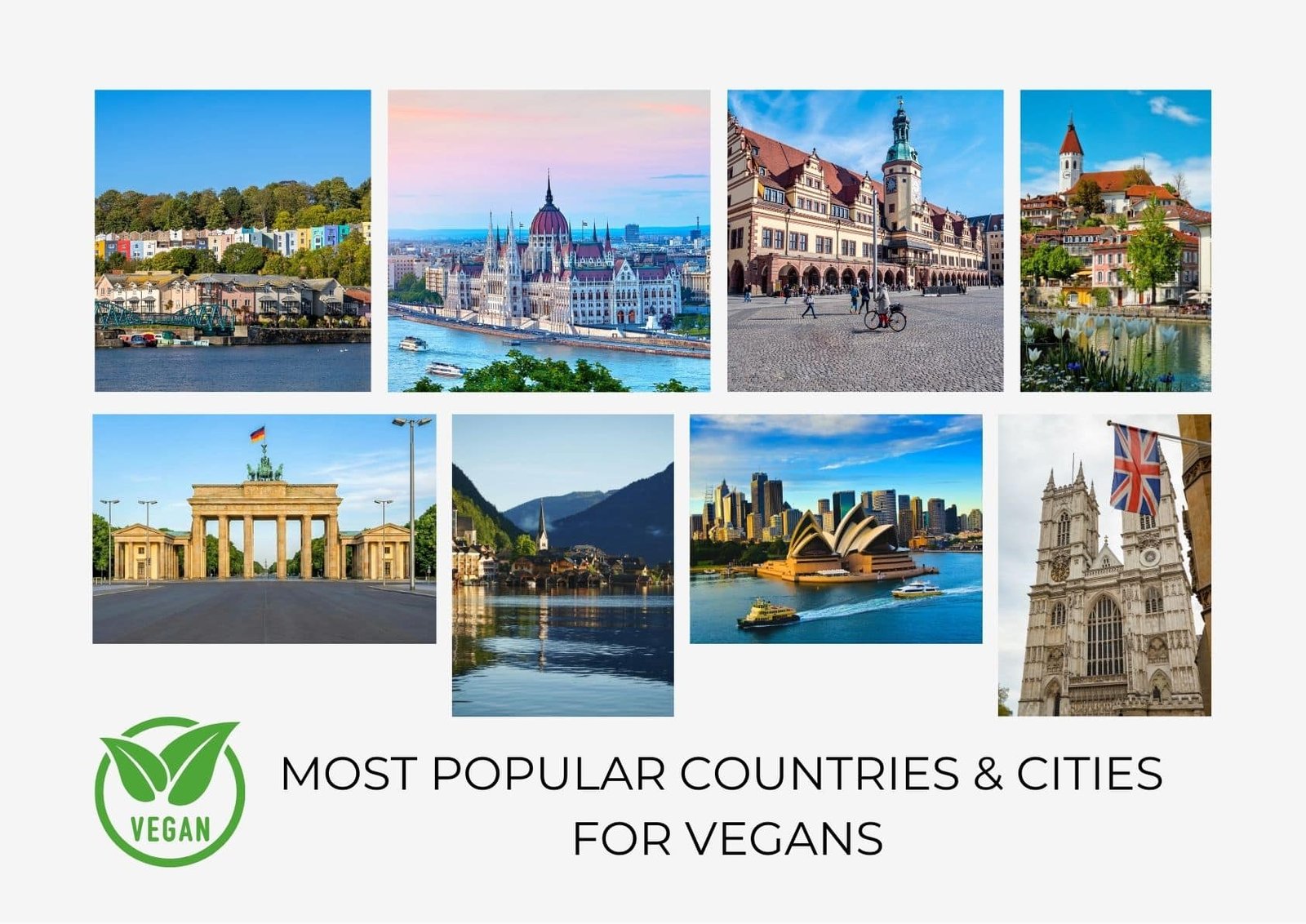

After years of rapid global expansion, the international vegan movement appears to have entered a more mature phase. In many countries, vegan buzz and media attention peaked several years ago, driven by novelty, product launches, and heightened environmental and health awareness. While global buzz dropped post-pandemic, moving into 2025 and 2026, global data suggests that veganism has largely stabilized, transitioning from a fast-growing trend into a more established part of everyday food culture.
While the momentum has dropped in some countries like Canada and the United States, there are many places where veganism is going strong. This sustained interest is reflected in other indicators: Germany’s vegan product market continues to grow, reaching €1.68 billion, while the UK now exceeds €1 billion, according to the latest data made available by GFI Europe. These figures underline how interest has consolidated into durable markets rather than fading.
Using Google Trends data for the full year of 2025 (Veganism as a topic, including searches for vegan restaurants, recipes, and products across languages), this Chef’s Pencil analysis highlights where plant-based eating remains most culturally and commercially relevant, revealing both stable global patterns and pockets of continued regional growth.
Top Countries for Veganism in 2025
Our report is based on Google Trends data, a reliable source of big data that shows the relative popularity of a search term on Google. Google Trends also allows you to geographically benchmark search popularity by providing interest scores for cities, regions, and countries.
For example, if Portland, Oregon, has a veganism popularity score of 100 and Berlin, Germany, has a score of 86, it means that a higher percentage of Portlanders searched for vegan foods and products compared to Berliners.
Germany Returns to The Top
Germany retakes the #1 position in 2025, an outcome that aligns with the country’s strong and mature plant-based consumer ecosystem. Germany is also Europe’s largest plant-based retail market by value across key categories tracked by GFI Europe, totaling €1.68 billion in 2024 (across six plant-based categories).
While a recent survey of 3,000 respondents conducted by the Max Rubner Institute reported relatively modest results—with just 1% identifying as vegan, compared to 2–3% in other studies—there are still many positive indicators for Germany’s vegan scene.
Germany ranks third worldwide for the number of animal product alternative companies and third for the number of restaurants offering vegan meals. Other studies also show a high proportion of Germans reducing their daily meat intake, further supporting the country’s strong position in the plant-based movement.

The UK remains very close behind in search interest and it also remains one of Europe’s biggest consumer markets for plant-based alternatives. GFI Europe reports the UK’s combined sales value across six plant-based categories at roughly €1.06 billion in the year to January 2025. The UK also ranks second worldwide for the number of vegan dining options and is home to the second-highest number of alternative meat companies in the world, according to a 2025 Vegan Society report.
Together, Germany and the UK illustrate something important: high vegan search interest often correlates with strong retail availability and mainstream product penetration—not just niche lifestyle adoption.
Austria, however, appears to be more of an outlier in this respect. While it ranks very high in relative search interest, its retail market size suggests that local search intensity may also be influenced by structural factors such as tourism (Austria ranks 5th worldwide for the number of restaurants offering vegan meals per capita), particularly in cities with significant international visitor traffic where vegan restaurant searches are common.
Switzerland now ranks fourth worldwide and is one of the countries with the largest ranking gains over the past decade. While its iconic foods, such as milk chocolate and cheese, are anything but vegan, the local vegan community continues to thrive.
This shift has not gone unnoticed by the restaurant industry: more than 20% of Swiss restaurants now offer vegan meals, placing the Alpine country fourth in Europe. Switzerland also ranks highly for the number of animal product alternative companies per capita, coming in fifth worldwide.
While the buzz around veganism has declined in recent years in Australia and New Zealand, both countries continue to be global strongholds for the movement and enjoy thriving local vegan communities. According to a 2025 Vegan Society report, around 3% of Australians now identify as vegan, up from earlier estimates of 1–2%. The same report notes that New Zealand offers the highest number of vegan dining options per capita globally, driven largely by non-vegan and non-vegetarian restaurants that regularly feature vegan options on their menus.
How Global Veganism Rankings Have Shifted Over the Past Decade
Germany and the United Kingdom emerged as the biggest winners over the past decade, rising to first and second place respectively after climbing five and six positions. Several Central and Western European countries recorded even stronger gains, most notably Hungary, the Netherlands and Slovakia, the former surging 18 places from 29th to 11th, representing the largest improvement in the dataset.
Hungary’s vegan scene is largely concentrated in Budapest, where a growing number of fully vegan restaurants, cafés, and plant-based businesses have helped drive national search interest. The capital has become the country’s undisputed vegan hub, supporting Hungary’s sharp rise in the rankings.
This growing momentum was reflected in the launch of Hungary’s first major Vegan Summit in 2025, which took place in Budapest on November 22 and attracted more than 600 participants.
Slovakia and the Netherlands likewise posted significant advances, each moving up nine positions, signaling rapidly growing interest in veganism in these markets.
The table shows the countries with the fastest ranking changes from 2016 to 2025.
In contrast, several early leaders experienced notable declines. Australia fell from first to fifth place, while Israel dropped five positions and Sweden saw the sharpest fall among top performers, slipping ten places from third to 13th. The United States and Canada recorded more moderate declines, suggesting a relative stabilization rather than a sharp loss of interest.
Overall, the data points to a clear shift in momentum toward Central and parts of Western Europe, where veganism appears to be gaining ground, while some traditionally strong markets have entered a more mature, slower-growth phase. This pattern supports the view that global interest is becoming more geographically diversified rather than concentrated in a few early-adopting countries.
Check out the interactive chart below, which shows how rankings have changed over the past 10 years.
Top Cities For Veganism in 2025
The most vegan-curious cities (measured by relative interest) include a mix of UK pioneers, German hubs, and standout North American metros, all located on the Pacific coast.
Google Trends highlights mid-sized and large global cities where relative interest in a given topic is especially high. For example, if Bristol has an index score of 100 and London scores 59, this means that a higher percentage of Bristol residents have searched for vegan-related topics such as recipes, restaurants, and clothing.
This does not mean that Bristol generated a higher absolute number of searches than London, which would be unlikely given London’s much larger population.
At the same time, Google Trends only highlights cities with a sufficient volume of searches. Smaller cities—typically those with populations below around 250,000—may not generate enough search volume to appear in the data. For example, Brighton has featured in past Chef’s Pencil reports, but it did not meet the minimum volume threshold this year.

Bristol has been one of the most consistent leaders in global vegan rankings for over a decade. It first reached the top spot in 2018, when Chef’s Pencil published its inaugural ranking of the world’s most vegan-friendly cities, and reclaimed first place again in 2020. Since then, it has remained firmly among the top three worldwide.
This long-standing success is rooted in both history and community. Veganism in Bristol is far from a recent trend; it has deep cultural foundations. The city has had regional vegetarian and vegan groups since the early 1970s, with the Bristol Vegans group, a community of more than 20,000 members, originally founded in 1994 and revived in 2006. The Bristol Vegan Fayre, running continuously since 2003, helped inspire similar events across the UK more than 20 years ago. Pioneering businesses such as Wild Oats (opened in 1981) and Essential Wholefoods (formerly Nova Wholefoods in the 1970s and ’80s) laid the groundwork for today’s thriving scene.
According to community member Isabella Gibbs, today’s vegan culture in Bristol is driven by both scale and spirit:
“We have this wonderful group with over 20,000 followers – Bristol Vegans – which has become a real hub for the community… Bristol has such a strong independent food scene, with long-standing fully vegan restaurants and countless cafés offering thoughtful, creative plant-based options as standard.
There’s also a real culture of activism and sustainability here. Veganism in Bristol feels woven into the city’s identity rather than a passing trend.”
As local oat milk producer Floatmylk notes, Bristol is one of the few UK cities able to sustain a city-based “oatery” distributing milk in reusable glass bottles, thanks to strong local support for sustainable food systems.
With nearly seven vegetarian and vegan restaurants per 100,000 residents—the highest ratio among German cities—Leipzig has earned its reputation as one of Germany’s true vegan hotspots. The city boasts dozens of fully vegan and vegetarian eateries, ranging from creative fine dining and international fusion cuisine to cozy cafés and fast-casual bistros. From plant-based brunch and artisan cakes to comfort food and experimental pizzas, Leipzig’s scene offers something for every taste.
The city even hosts a dedicated vegan Christmas market, reflecting how deeply plant-based culture is woven into local life. With its strong community, culinary diversity, and year-round enthusiasm for vegan food, Leipzig stands out as a genuine vegan mecca in Europe.
With its amazing variety of vegan restaurants, cafés, food carts, bakeries, and plant-based comfort food, Portland, Oregon has long been a pillar of vegan culture in the United States. For nearly a decade it’s consistently ranked among the top three or four vegan cities worldwide, a rare and sustained achievement in a food landscape where buzz has declined in many U.S. markets.
Portland’s scene includes beloved vegan staples, from soul food and Southern classics at Dirty Lettuce to innovative plant-based pizzas, doughnuts, and fine-dining options, making it a destination for both locals and visitors seeking culinary creativity without animal products.
Even as mainstream vegan interest has softened across the U.S., Portland—alongside its Pacific Northwest neighbors Seattle and Vancouver, as well as major hubs such as San Francisco and Los Angeles—continues to thrive as vibrant centers of plant-based dining and culture.
Methodology
Chef’s Pencil has analyzed Google Trends data for the full year of 2025. Google Trends popularity scores are relative and not absolute. Please see below how Google defines regional popularity scores:
Values are calculated on a scale from 0 to 100, where 100 is the location with the most popularity as a fraction of total searches in that location, a value of 50 indicates a location which is half as popular. A value of 0 indicates a location where there was not enough data for this term.
Note: A higher value means a higher proportion of all queries, not a higher absolute query count. So a tiny country where 80% of the queries are for “bananas” will get twice the score of a big country where only 40% of the queries are for “bananas”.
Fair Use and Redistribution
Chef’s Pencil grants you permission to reuse, host, or repost the graphics and images from this article. When doing so, we ask that you kindly attribute the authors by linking to Chef’s Pencil or this page.