

“I’m actually Irish, born and raised,” says Jen Murphy, owner-operator of the new Manhattan bar Banshee. “I learned a long time ago you actually have to specify that.”
Murphy, a veteran of the East Village bar scene, moved to the U.S. in 2014. It didn’t take long to notice that Irish American pride ran deep enough for people to comfortably declare themselves Irish, even many generations removed—but also that the manifestations of Irish culture in the States weren’t always aligned with her experience back home. Take the pub: Growing up in a small town in Ireland, she says, it was a place to bring the kids, to celebrate first communions and attend wakes, often with a grocer, gas station, or even funeral home attached. The ubiquitous American “Irish bars,” on the other hand, have “become their own beast… that kind of Disney-Irish Times Square thing.”
With Banshee, she wanted to show New Yorkers something different. “We’re so good at adapting, immigrating and then just giving the people whatever they want,” Murphy says. “But I have more ‘notions,’ I think, as some Irish people would say.”
Murphy’s is one of a clutch of new Irish-led bars and restaurants that have started playing with the pub form in recent years—whether that means embracing cocktails, bringing on ambitious chefs, incorporating unexpected influences or just making a point to subvert expectations. At Banshee, that looks like a surprising signature pairing of Guinness and oysters—an old-school combination in Irish seaside towns, with echoes of New York’s Martini-and-oysters culture—and a space decorated with work by artist friends from the East Village scene. At The Harp, opened a few months ago in Washington, D.C., you can enjoy a traditional music session over pan-fried monkfish with chanterelles and an “Irish Boulevardier.” At McGonagle’s, a year-old pub in Boston, the kitchen is helmed by chef Aidan Mc Gee, who once worked under Heston Blumenthal.
It’s perhaps a ripe moment for an Irish pub-aissance, with Irish stars increasingly spangling U.S. bookshelves, movie theaters, and playlists—just look at the 2024 New York magazine package exploring “how the Irish came to rule pop culture.” Another cultural ambassador that everyone’s swooning over: Guinness. Thanks to shrewd marketing (and TikTokers challenging us all to “split the G”), on-trade sales are booming, and you’ll find the stout on draft and in cocktails at all kinds of trendy spots. Irish drinking culture is about much more than just Guinness, of course—but amid this groundswell of interest and appreciation, U.S. audiences just might be ready to broaden their idea of what an Irish bar can be.
Banshee, in New York’s East Village, serves Guinness and oysters, an old-school Irish seaside pairing.
One of the country’s most celebrated new pubs is The Wren, in Baltimore, which has recently been recognized by both Bon Appétit and the New York Times. Millie Powell and Will Mester, who are co-owners along with partner Rosemary Liss, say they wanted to create “an honest expression” of the format, “rather than the paddywhackery of what many Irish pubs are in the U.S.” A pub is not just a place to get a drink, but a place where life happens—a reality especially underscored by the pandemic, when many were forced to close down.
Though the ever-changing menu is a step up from your standard pub grub, The Wren doesn’t mess too much with tradition. The building has been in use as a drinking establishment since 1890, and the team kept the original bar intact, adding milk-glass lights and wood paneling and dividers—“a nod to many of the Victorian bars you would often see around Dublin.” You can order a packet of Tayto crisps or a strong cup of tea. There’s no music over the speakers, no sports on a screen behind the bar. In a true Irish pub, Powell and Mester explain, all you hear is “the din of conversation, the sound of a Guinness being poured.”
Some of the groundwork for this Irish-pub inflection point can be credited to The Dead Rabbit, which opened in New York City in 2013 and quickly became one of the country’s most celebrated bars. Seeing Irish pubs in the States reduced to “essentially sports bars with an Irish flag in the front,” says Jack McGarry, inspired him and co-founder Sean Muldoon to “really lean into our Irish identity, and to challenge as many misconceptions as we could.” That included not only embodying contemporary Irish pub culture, but also aligning with Ireland’s long tradition of anti-imperialism and progressive politics. “We take very strong positions,” McGarry says. “But to me, that’s part of the Irish story. You have to be who you are, and you have to say it.”
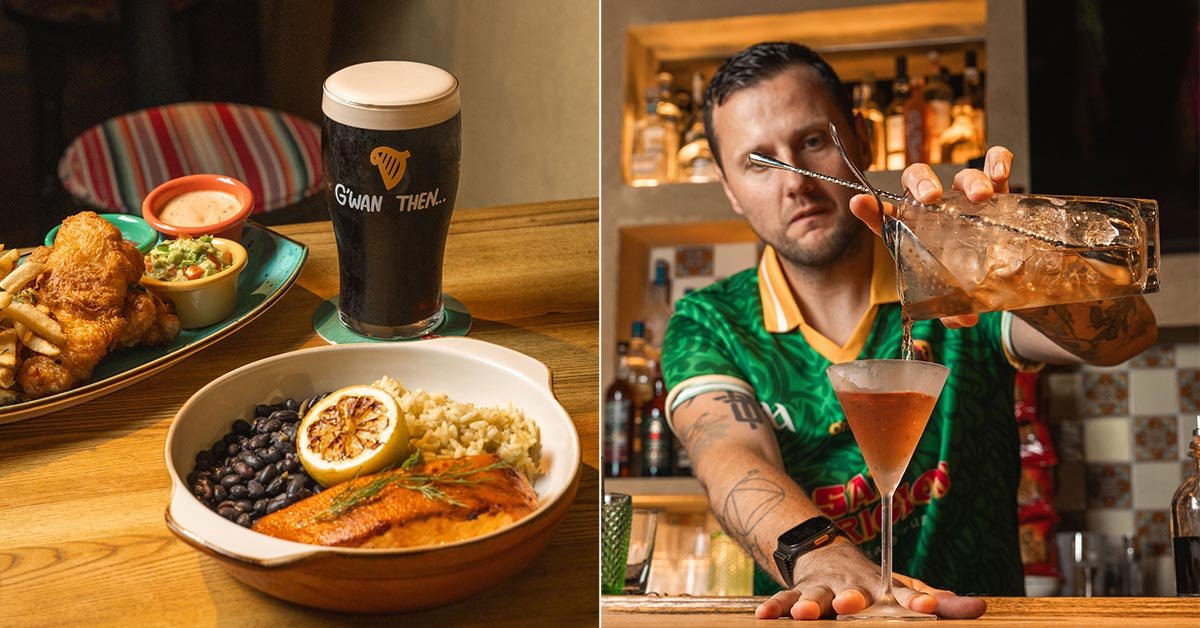
For San Patricios, which opened in September in Jersey City, McGarry looked to the history of Irish radicalism to meet the current moment in the U.S. “I’m really frustrated with the representation of immigrants with this current administration,” he says. He found a metaphor for the solidarity he wanted to express in the story of the Saint Patrick’s Battalion: a Mexican unit during the Mexican-American War that included many Irish immigrants who had deserted from the U.S. army, mistreated by superiors and politically opposed to carrying out the country’s colonial ambitions.
“To me, that’s part of the Irish story. You have to be who you are, and you have to say it.”
McGarry saw overlap between the “revolutionary stories, and transitory stories, of both cultures.” He also saw the possibilities in exploring what’s shared between Mexican and Irish food and drink—subtle similarities he first noticed spending time with Mexican colleagues at The Dead Rabbit. He brought the idea to longtime bartender Diego Livera, who grew up in the Mexican state of Morelos. Livera signed on as bar manager right away; soon after, chef de cuisine Joel Franco (also from Morelos) and sous chef Daisy Nando (born in New York and raised in Puebla) came on board from The Dead Rabbit to lead the kitchen.
In 2026, San Patricios will open a separate downstairs bar called Life of Reilly—a sly reference to battalion leader John Riley—where cocktails will be center stage. And McGarry and co. have also been exploring Irish café culture at Grá Mór, an all-day concept that opened in September next to The Dead Rabbit’s Austin outpost. It’s a way to introduce new audiences to another facet of Irish cuisine, but McGarry also describes it as a kind of testing ground for how the pub format can adapt to changing tastes and drinking behaviors. “I don’t like the sort of binary nature of drinking and non-drinking,” he says; he himself stopped drinking alcohol around 10 years ago. Part of what kills bars, he says, is staying set in your ways.
“When I first came to America, they were actually writing articles on the death of the Irish pub,” McGarry remembers. “The Irish pub is never going to die. But it has to be done right.”