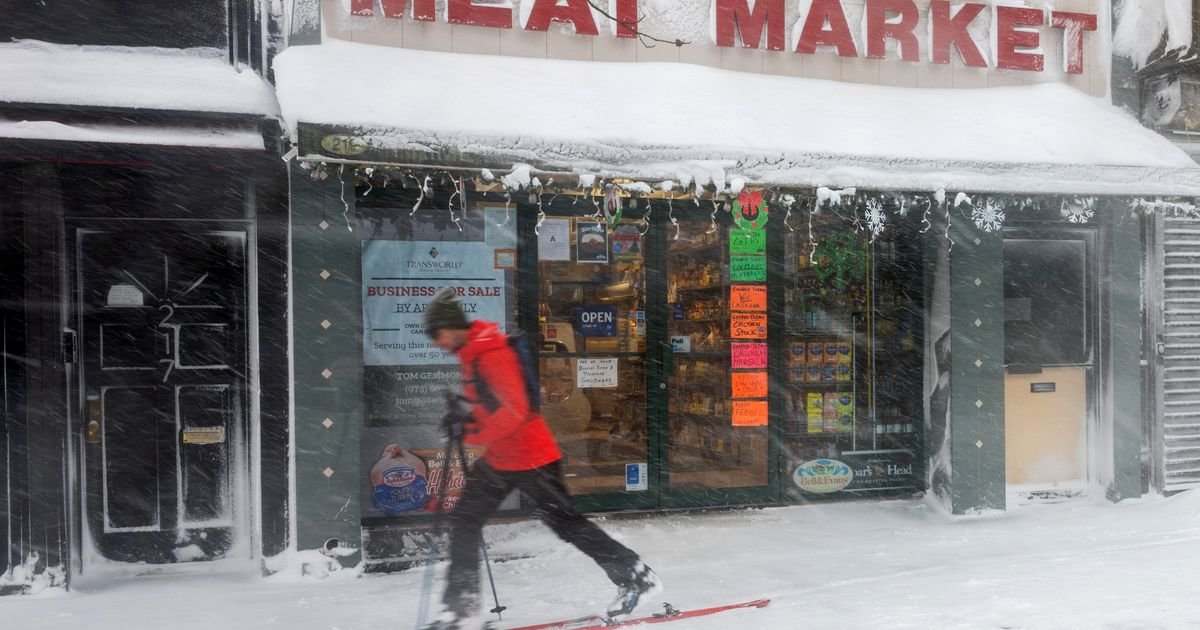

The snow was fun for some but caused headaches for restaurants still recovering from last month’s snowstorm.
Photo: Spencer Platt/Getty Images
Valentine’s Day fell on the Saturday before Presidents’ Day this year, a once-every-few-years gift that, for New York City restaurants, is a bright spot during the usual slog of February. “It basically gave us a supersize weekend, between Friday, Saturday, and a Sunday before the federal holiday that most diners treated as another weekend night,” says Max Katzenberg, co-owner of Tokyo Record Bar and director of operations for Roscioli NYC. “It was a little profit, a little breath of air,” he says. “All of that got totally wiped out by this storm.”
When reports of a major blizzard headed for New York City began circulating on Friday, Katzenberg took to his phone to refresh the weather report and to watch for guidance from the city government. “It’s always so minute to minute,” he says. “We were like, ‘Okay, it’s going to be a late-starting storm, so we’ll be able to do a full night of service on Sunday.’” By Sunday afternoon, Mayor Zohran Mamdani had declared a ban on nonessential travel from 9 p.m. to 12 p.m. on Monday, and the plan changed.
“A couple of weeks ago, when that first big storm happened, we were kind of like, ‘Okay, we expect this to happen once a year,’” says Halley Chambers, co-owner of Margot and Montague Diner. “We worried about our team’s ability to transport themselves to the restaurant safely, and reservations are low, so we just decided to close.”
But facing that same decision again so soon forced Chambers and other operators to weigh the consequences of an unplanned closure anew. (Both Margot and Montague Diner stayed open for dinner until the travel ban went into effect on Sunday.) At Roscioli, Katzenberg sent off a round of emails to regulars within walking distance who might want to come in for a bowl of pasta; Chateau Royale owner Cody Pruitt opted to keep the bar room open for the neighborhood, because who doesn’t crave a martini in a snowstorm? “It’s less about scaling back ambition and more about being pragmatic,” he says. Shutting down is a last resort: “Every closure sets off a chain reaction, from the reservations we have to cancel to guests who are disappointed, product sitting in our walk-ins that has a clock on it, and revenue that’s just gone,” adds Ayesha Nurdjaja, chef and owner of Shukette and Shuka.
Takeout-dependent businesses don’t fare much better but for different reasons. If anything, adding a middleman to the equation in the form of a delivery app only complicates things. “One of the most frustrating parts is when the delivery apps stay open when they shouldn’t and take orders without having enough drivers to actually pick them up,” says Ann Redding, co-owner of Thai Diner and Mommy Pai’s, the takeout- and delivery-only fried-chicken spot in Nolita. “That’s tough on us and tough on guests. Orders sit, ETAs get pushed, and no one’s happy.” Nurdjaja adds that the “whole delivery system” needs to become more streamlined and responsive: “The platforms aren’t always quick enough to turn off service.”
And as anyone who’s tried to navigate the city’s slush mountains knows, a storm’s impact doesn’t end when the last snowflake hits the ground. “We just kept getting emails from yesterday to right now from our vendors — wine, fish, vegetables, everything — so we decided like an hour ago to not open Tuesday,” says Ronan Duchêne Le May, owner of La Chêne. Similarly, Chambers and her partner, Kip Green, spent Monday morning fielding calls from vendors who were unable to make deliveries in the snow, and then game-planning how to “function without the basic inputs that make a restaurant work, like produce and labor.”
Unshoveled sidewalks and out-of-commission public transit also hamper foot traffic in both a figurative sense — “No one wants to sit down to eat with wet or dirty clothing,” says Ernesto’s and Bartolo owner Ryan Bartlow — and literally. “If walkways don’t get cleared, as was this past month or so, there is nowhere for people to walk, stroll, or have fun,” says Dennis Spina, chef and owner of Cafe Kestrel in Red Hook. “We’ve been lucky by Red Hook standards, but that’s not to say that we aren’t reliant on foot traffic or a lovely stroll that ends with dinner or lunch here on the weekends and nicer days. It has made the weekday services especially challenging.”
More than anything, restaurateurs I spoke to are tired of having to shoulder the burden on their own: “It’s easy to just say, ‘Oh, what a shitty start to the year,’ but I think coming out of the pandemic, we actually haven’t done a lot as a city to figure out how to support small businesses … once again, owners are in the position of needing to generate revenue without resources available,” says Chambers, who is in support of a winter rent subsidy for independent restaurants faced with unexpected closures.
“In a perfect world, I’d love to see the city offer direct grants to independent restaurants when there’s a declared weather emergency. Something that actually offsets the lost revenue, or at a minimum helps cover labor so operators aren’t pushing the cost onto their staff’s PTO,” says Nurdjaja. “We’re the restaurants that keep neighborhoods running, that employ people year-round, that contribute to the city’s tax base. When New York shuts down, we absorb that loss almost entirely on our own. Some form of real, structured support from the city would make such a meaningful difference.”