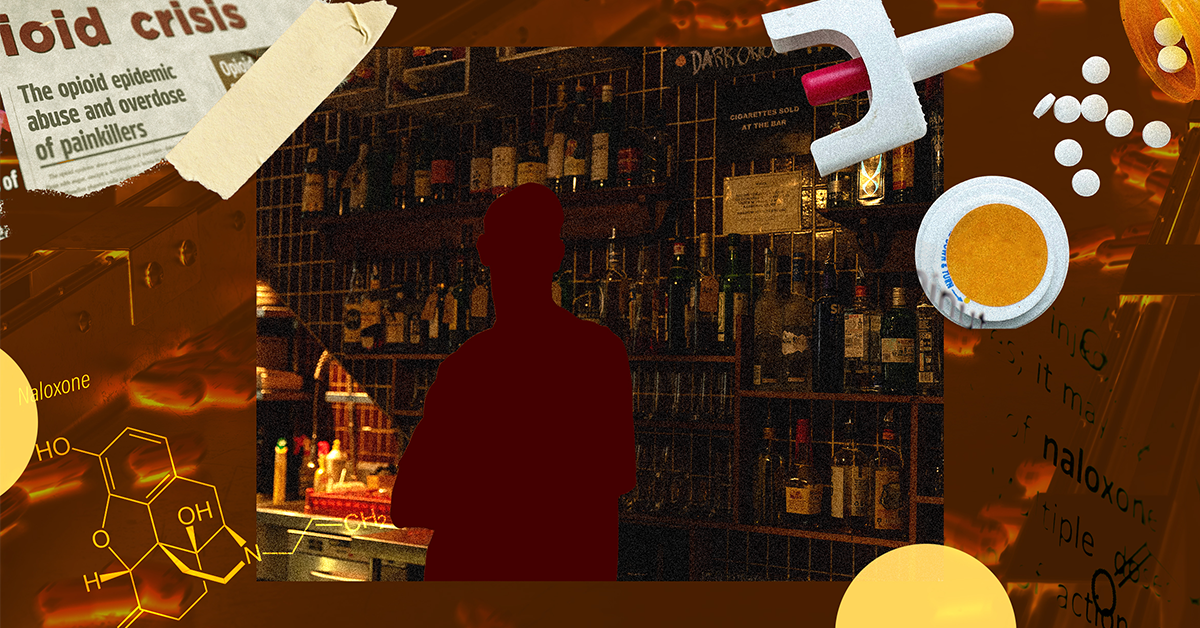

Benjamin Diepholz has been in the bar and restaurant industry on and off for 18 years. For the past three years, he’s worked at a kava bar in Asheville, North Carolina, and in previous roles, he’s designed menus, made 20-30 gallons of soup at a time, and tended bar working a dozen drinks deep. But nothing prepared him for what happened this September.
One day that month, two men entered the bar. One asked for a cup of water. As Diepholz stepped outside for a cigarette, he peered in and saw one of the two men slumped over some books, snoring. Diepholz has struggled with substance use in the past, and has carried Narcan for years. He jumped into action: He approached the two men, explained what the Narcan did, administered it, and counted to 10. When the snoring man didn’t wake up, he called an ambulance, and emergency responders arrived within minutes. “I saw the emergency workers helping him with urgency, and then that urgency kind of left,” he says. “They slowly put him in the ambulance and drove away without the lights on.”
It was obvious that the customer had died in the bar, even after Diepholz’s best attempts to save his life. Diepholz kept the incident to himself for about a week, and talked to his therapist about it. He says that there is still a big stigma around substance dependency within the hospitality industry that impacts how staff are trained to respond when overdoses happen at work. “We’re taught to deal with the stress of being in the weeds, but when someone really needs help, we freeze,” he says.
If hospitality workers are tasked with navigating these traumatic events, who is there to support them?
“We’re taught to deal with the stress of being in the weeds, but when someone really needs help, we freeze.”
Substance dependency has impacts on both sides of the bar. The hospitality industry has long been associated with drug use, but over the past 30 years, that reality has been underscored by the opioid epidemic. In 2023, more than 200 people in the U.S. died per day due to an opioid overdose, though that was the first year where opioid deaths decreased since 2018. A significant amount of those gains were due to expanded telehealth access for opioid treatments, such as methadone, which helped people in recovery stay on their medicine and avoid relapse. However, many of those gains rolled back in September, due to a lack of Congressional approval and the government shutdown.
Over the past 30 years, Daliah Heller, the vice president of overdose prevention initiatives at Vital Strategies, a global health organization, says that it’s become clear that industries that require physical exertion have higher opioid use than others.
Bartending, for example, requires long hours and physical labor. When workers in this industry sustain an injury, there is pressure to push through it and continue working, leading some to self-medicate. High-pressure situations are commonplace, and finding ways to cope with them becomes paramount. According to a 2015 report by the Substance Abuse and Mental Health Services Administration, the hospitality industry has the highest rates of substance abuse disorder, and the third-highest rates for heavy alcohol consumption. Because heavy substance and alcohol use is so normalized in the industry, those with addiction may find it hard to seriously talk about it.
The structure of the industry, too, can be a barrier. According to December 2024 data from the Independent Restaurant Coalition, only about 32 percent of food service employees have access to employer-sponsored health care compared to 77 percent of workers across the private sector. The threshold for Medicaid eligibility shifts from state to state. Alex Jump, the director of operations at Focus on Health, a harm reduction training organization based in Denver, says that restaurant workers earning $21,600 annually, or about $1,800 per month, do not qualify for Medicaid in Colorado.
“Historically, this has been a topic shrouded in shame and guilt.”
Ellen Wirshup, the program director for Project RED, a harm prevention organization in Portland, Oregon, fell into her role through a personal tragedy. In June 2022, a very close friend who worked as a bartender died after work one night. They’d been in recovery, but went home, took a pill, and never woke up.
Wirshup has also been a bartender for the past decade, and felt helpless. Here was this friend who was gone forever when they could have been saved from a dose of Narcan. Similar to Diepholz, grief pushed Wirshup into action: She visited her local recovery center, the Alano Club, and picked up a few cases of Narcan. She conducted her own harm prevention training, walking from bar to bar in the neighborhood talking to employees about what Narcan was and how to use it before leaving them with a box. By August, Wirshup’s DIY operation became a fully-fledged job.
Harm reduction does have its limits, Heller says. For example, some club owners have refused to stock fentanyl test strips or other tools, out of fear that it would encourage drug use. Wirshup, too, has noticed a local downward trend; fewer bars and restaurants are requesting Narcan.
Other grassroots efforts have sprung up to fight stigma and keep clients safe throughout the hospitality industry. For example, Focus on Health offers a Harm Reduction and Overdose Prevention training course for restaurants. To date, more than 250 bartenders have learned harm prevention tactics through the programs at major events like Tales of the Cocktail and Portland Cocktail Week. With more people armed with the training, the idea is that the work, and emotional toll, is shared more equally on bar and restaurant teams.
Other structural solutions that restaurant owners can lean into are finding flexible benefits packages that offer more mental health resources, such as those from OS Benefits, which was built by and for hospitality workers. Often, the premiums are less than what employers would pay on the private marketplace.
Jump also advocates for policies barring substance use from the workplace, and offering workers resources before firing them arbitrarily for their first offense. “Historically, this has been a topic shrouded in shame and guilt,” says Jump. “The pressure of being the people who are expected to be the champions of good times and the curators of parties… makes it hard for our industry to open up when we are struggling.”