
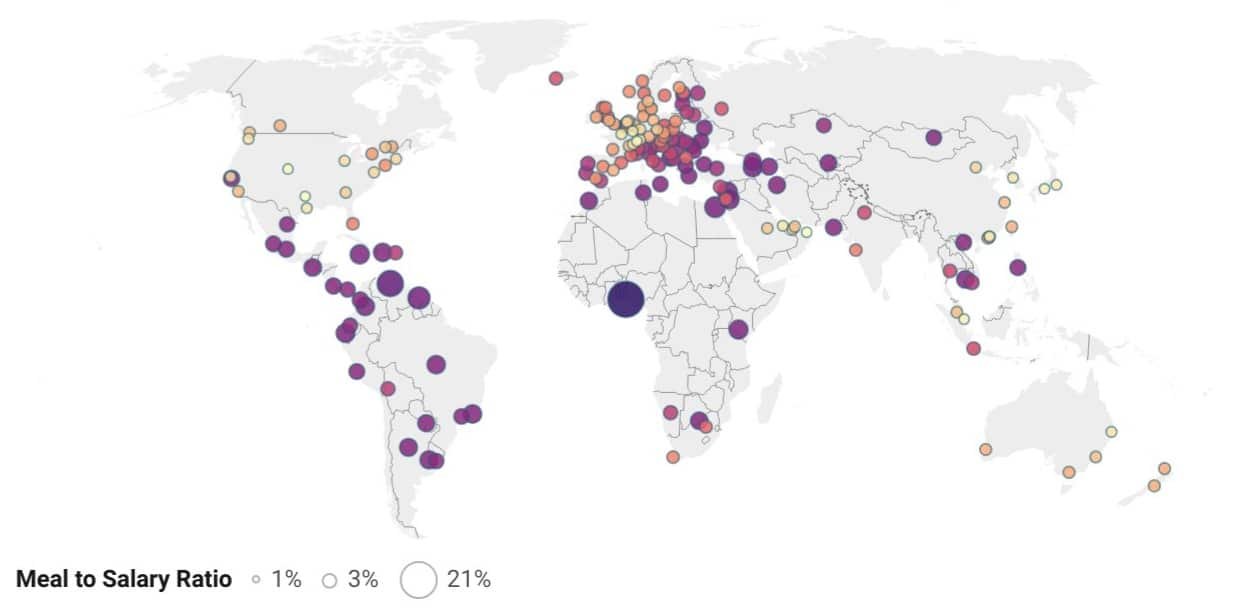

Is spending $50 at a restaurant expensive? What about $80 or even $150? Like most things in life, the answer is relative—it depends on where you are, the type of restaurant you’re visiting, and what you can comfortably afford.
That said, in some cities dining out is far more affordable for locals than in others.
Chef’s Pencil analyzed restaurant price data and compared it to local wages across more than 170 cities worldwide to uncover where eating out is most affordable—and where it’s the most expensive—for the local population.
The data was sourced from Numbeo, a large crowdsourced database that tracks both cost-of-living and wage data around the globe. While not as rigorous as official government statistics, it’s a valuable tool for spotting global trends.
Like any crowdsourced dataset, it has some quirks—updates can be uneven across cities, averages don’t always capture the full picture and may include some level of subjectivity (e.g. what constitutes a “mid-range restaurant” or a “cappuccino” can vary wildly between individuals and cultures), and cultural factors like tipping aren’t included. Still, these limitations tend to affect most cities in similar ways, making the comparisons a useful guide to affordability worldwide.
Cities Where Eating Out is Most Affordable in Mid-Range Restaurants
With some exceptions, mid-range restaurants are the most common dining establishments and provide one of the best indicators of how expensive a city is for eating out. To measure affordability, we compared the cost of a three-course meal (sourced from Numbeo) with the average monthly net wage across 177 global cities. Numbeo reports prices for two people, so we adjusted the data to reflect the cost for a single individual.
The results show stark contrasts between regions, with affordability in some cities being more than 25 times higher than in others—and with some surprising entries near the top.

The “1% Club”: Where Eating Out Costs 1% (or Less) of Monthly Income
Joining what we call the “1% Club,” there are 26 global hotspots where locals spend just 1% or less of their monthly take-home pay on a mid-range meal. The majority are in the United States (9 cities) and East Asia—Japan, China, and South Korea (7 cities)—with the rest spread across Europe and the Middle East, and one in Australia.
Dallas, United States, ranks first, with just 0.7% of the average monthly salary (take-home pay) needed to cover the cost of a mid-range meal. Numbeo reports average net earnings of $4,686 per month, with a three-course meal for two costing $70 (or $35 per person).
However, this raw data doesn’t account for a crucial cultural factor: tipping, which is typically higher in the U.S. than elsewhere. Adding a standard 15%–20% tip raises the cost to around $40–$42 per person. This adjustment lowers Dallas’s affordability ratio slightly, though it still remains among the highest in the world—illustrating how service charges can significantly affect the real cost of dining out in the U.S.
Muscat, Oman’s capital, ranks second, where a typical meal accounts for about 0.8% of the average monthly salary. This high affordability comes from the relatively low cost of dining (about $13 per person for a mid-range meal) combined with relatively high local earnings, making Muscat one of the most affordable cities for residents and a great deal for tourists as well.
Unlike the U.S., tipping is not mandatory in Oman, though a 5%–10% tip may be offered for exceptional service. As a result, the listed prices closely reflect the true cost of dining out. This makes Muscat’s affordability ranking especially accurate and highlights how cultural practices around service charges can significantly influence international comparisons.
Bern, Switzerland’s capital, comes third. Switzerland is widely regarded as one of the most expensive countries in the world, and Bern’s average meal price of nearly $120 per couple reinforces that reputation. However, once very high local wages are factored in, dining out is more affordable for residents here than in nearly every other city worldwide.

In Europe, Switzerland dominates the leaderboard: Bern, Zurich, and Geneva are among the most affordable for dining out relative to local wages. Paris (14th worldwide) and Luxembourg City (another city known for its high cost of living, but also high wages) also rank highly, while Germany’s major hubs such as Frankfurt (24th worldwide) and Berlin (33rd) land in the upper-middle of the global ranking. It’s also relatively affordable for locals in The Hague, Prague, Gothenburg, Lyon, Amsterdam and Valencia to eat out.
By contrast, many cities in Southern and Eastern Europe show significantly lower affordability. In Italy, for example, residents of Milan, Naples, and Florence can only afford to dine out about a third to half as often as their Swiss counterparts. In Greece, Athens (143th worldwide) ranks near the bottom of the European and global table, sandwiched between Kyiv and Manilla, highlighting how restaurant meals are comparatively less accessible to the local population despite the city’s vibrant dining scene. Similarly, in Croatia, Dubrovnik posts one of the lowest affordability scores in Europe, underscoring the high gap between tourist prices and local purchasing power.
Further north, Bucharest (127th), Belgrade (120th), or Chisinau (132nd) also record modest affordability, albeit higher than Athens, while the Baltic capital cities of Tallinn (125th) and Riga (123rd) also perform modestly , illustrating the east–west divide in Europe’s dining costs relative to wages.
Regional Inequalities
The disparities are even more pronounced when comparing across continents.
In North America, U.S. cities dominate the top half of the list, with three ranking in the global top 10. Canada’s largest hubs—Vancouver (32nd), Montreal (50th), and Toronto (56th)—rank lower overall, reflecting higher restaurant costs relative to wages, yet all three still outrank major U.S. cities like New York (62nd) and Miami (71st). Further down the scale, Monterrey (131st) and Mexico City (146th) are substantially less affordable than their American and Canadian counterparts.
In Asia, wealthy cities such as Singapore, Tokyo, Shenzhen, Doha and Seoul offer high affordability, but affordability plunges in South and Southeast Asia. For example, Mumbai (73rd), Bangkok (95th), and Manila (145th) are far below their East Asian counterparts.
Africa presents the widest gap: Cape Town, South Africa (69th) performs moderately well, on par with Madrid, Miami or Copenhagen, while Lagos, Nigeria, sits at the very bottom of the ranking, with locals being able to afford dining out fewer than 5 times per month on average.
In South America, affordability is consistently lower, with La Paz (109) performing relatively better, while Rio de Janeiro (163rd worldwide) and Buenos Aires (162nd) illustrate the financial challenges locals face in dining out. Caracas, Venezuela (175th), underscores the impact of hyperinflation and economic instability.
In Australia and New Zealand, dining affordability sits in the middle to upper range globally. Brisbane stands out, ranking 13th worldwide and well ahead of other cities in the region. Elsewhere in Australia, Sydney, Melbourne, and Perth show very solid but lower affordability levels. Across the Tasman Sea, Auckland and Wellington post nearly identical scores, placing both countries in line with many Western European cities but below the top-ranked hubs in North America and Asia.
The Bottom of the Ranking
At the lower end of the global spectrum, affordability drops sharply. In cities such as Cairo (Egypt), Kingston (Jamaica), and Nairobi (Kenya), eating out is more of a luxury, affordable only to a limited segment of the population. Caracas, Venezuela, and Lagos, Nigeria rank as the least affordable cities in the world for dining out.
Cheap Eats – Asia Dominates the Top
While mid-range restaurants provide a useful measure of dining affordability relative to wages, inexpensive meals are often a better reflection of everyday eating habits. We analyzed the cost of an inexpensive meal (sourced from Numbeo) against the average local salary. This ratio indicates how many such meals a person earning an average wage could afford in a month, highlighting the stark disparities between wealthy and developing economies.
The most affordable places for budget dining are concentrated in Asia. Singapore (0.20%) tops the global list, where a typical inexpensive meal represents just a fifth of one percent of the average monthly salary. Put another way, a Singaporean earning the city-state’s average salary could afford to eat out nearly 500 times per month if they spent their entire income on inexpensive establishments.
Shenzhen (0.21%), Hong Kong (0.22%), and Doha (0.26%) follow closely, all showing that cheap eats take up only a fraction of local wages.
Other high-income Asian hubs like Seoul (0.26%), Tokyo (0.31%), and Osaka (0.33%) also rank among the most affordable worldwide, confirming how strong local wages drive accessibility.
In Europe, affordability is driven less by price and more by earnings. Bern (0.38%) and Zurich (0.39%)—despite some of the highest absolute meal prices in the world—remain in the global top tier once adjusted for income. North American cities such as Denver (0.37%), Seattle (0.38%), and Chicago (0.39%) show a similar pattern.
Least Affordable Cheap Meals
At the other end of the spectrum, inexpensive meals consume a much larger share of local wages. In Cairo (2.29%), Lagos (2.49%), and Caracas (3.63%), even budget dining takes a heavy toll on incomes. In these cities, the affordability ratio is more than ten times higher than in Singapore or Shenzhen.
Latin America also records some of the highest ratios, with Buenos Aires (2.34%), Georgetown, Guyana (2.16%), and Rio de Janeiro (1.67%) showing how economic pressures make dining out difficult for many locals. Eastern Europe and the Balkans fall into the mid-to-high range, with cities like Athens (1.46%), Dubrovnik (1.40%), and Bucharest (0.98%) well above the European average.
Where Coffee Is the Most Affordable
For many people, a daily coffee is more than just a beverage—it’s a ritual. But how affordable is it to enjoy a cup of coffee, such as a cappuccino (or an equivalent coffee drink like a latte or flat white), every day? By looking at the price of coffee as a share of the average local salary, we see sharp contrasts across regions.
Switzerland, Italy and US – Most Affordable Coffee Cultures
Coffee is most affordable in high-income countries, where wages significantly outpace beverage prices. However, cultural norms also play a major role in coffee affordability: while Italy doesn’t have the highest wages in the world, its strong café culture keeps prices low and daily coffee highly accessible.
Swiss cities lead the way, with Geneva and Bern (2.4%) at the very top, followed by Zurich (2.5%). Despite Switzerland’s reputation for sky-high costs, high wages mean locals can easily afford daily café visits.
Values in brackets represent the share of average income that would be spent on drinking one cappuccino (or equivalent) every day.
Italy also features prominently, with Rome (2.4%), Milan (2.8%), Florence (3.0%), and Turin (3.0%) proving that the country’s strong café culture is supported by affordability. In North America, San Francisco (2.5%), Seattle (2.6%), Boston (2.6%), Washington D.C. (2.9%), New York, and Chicago (all around 2–3%) rank among the best places to enjoy a coffee daily without it putting a dent in the budget.
Australia and New Zealand also stand out, with Sydney (2.6%), Melbourne (2.7%), Brisbane (2.7%), Perth, Auckland, and Wellington (all 3%) making coffee a relatively accessible everyday treat.
Moderate Affordability Across Europe and Asia
In much of Western and Northern Europe, coffee affordability remains strong but not exceptional, with cities like Amsterdam, Frankfurt, Madrid, Berlin, and Paris (3–4%) hovering near the middle of the ranking. In Asia, Singapore (3%) and Seoul (3%) perform well, while Tokyo and Osaka (4%) show similar affordability levels to many European cities.
Where Coffee Becomes a Luxury
Affordability declines steeply in emerging economies. In Athens (10%), Delhi (10%), and Mumbai (10%), a daily cappuccino takes up around one-tenth of a worker’s average daily income. In Santiago, Ho Chi Minh City, and Tashkent (11%), the share is even higher.
At the bottom of the global ranking are cities where wages are extremely low compared to beverage prices. In Cairo (25%), Caracas (26%), Karachi (29%), Georgetown (32%), and Lagos (57%), buying a coffee every day would consume a huge portion of monthly wages—making it a true luxury rather than a daily habit.
Key Takeaway
While a cappuccino (or an equivalent coffee drink like a latte or flat white) is an everyday indulgence in wealthy countries—especially Switzerland, Italy, the U.S., and Australia—in many parts of the world, it remains prohibitively expensive relative to wages. In Türkiye and some other cultures, a cappuccino is often seen as a more premium, “Western-style” coffee, while traditional Turkish coffee is cheaper and more widely consumed—something that can influence affordability rankings.
Where Beer Is the Most Affordable
China leads the global ranking for beer affordability. Shenzhen and Shanghai (0.4%) top the list, with Beijing (0.5%) close behind. Thanks to low beer prices combined with relatively high urban wages, locals in these cities can enjoy domestic brews at some of the lowest income shares worldwide.
Values in brackets represent the share of average income that would be spent on drinking ten average-priced domestic beers per month.
However, it is worth noting that most beer sold in China is lighter, more watery, and has a lower alcohol content compared to typical beers in Europe or the U.S. While this makes it easy to drink in large volumes—especially in hot summers—it also contributes to China’s reputation for “cheap beer.”
Other highly affordable beer markets include Tokyo (0.6%), Seoul (0.6%), and U.S. cities such as Atlanta (0.6%) and San Francisco (0.7%). Although beer prices in San Francisco hover around $8 per glass—and are also relatively high in cities like Bern or even Atlanta—local wages offset these costs, keeping the affordability ratio low.
Europe’s traditional beer hubs also feature prominently. Prague (0.8%), Antwerp (0.9%), Luxembourg City (0.8%), and Den Haag (0.7%) highlight how both strong beer cultures and high wages make beer broadly accessible. Among German cities, Berlin (0.9%) ranks 24th worldwide, underscoring that while Germany is a beer powerhouse, affordability varies across its major cities.
Additional Visuals

Methodology
This report is based on data from Numbeo, an online platform that tracks cost-of-living and wage information worldwide. We analyzed data for more than 180 cities across all continents.
Mid-Range Restaurants: Numbeo reports the cost of a three-course meal for two. To standardize, we halved this figure to represent the cost per person. Affordability was measured by dividing the average net monthly wage by the price of one meal, resulting in the number of times a local could dine out per month.
Cheap Eats: Inexpensive meals are defined by Numbeo as a simple meal at a casual restaurant. We calculated the meal price as a percentage of the average monthly wage (the “inexpensive meal ratio”).
Coffee: We used the reported average price of a cappuccino or similar coffee and expressed it as a share of local monthly wages.
Beer: The “domestic beer ratio” reflects the cost of a locally brewed beer (0.5 liter draft or bottled) relative to local wages.
Currency & Wages: All wage data represent net (after-tax) monthly income in local currency, converted to USD. Numbeo updates its data regularly through user submissions and statistical validation.
While these indicators provide strong cross-city comparisons, results should be interpreted with the following caveats:
Prices may not include gratuities or service charges, which can significantly impact final costs, particularly in countries like the United States where standard tips range between 15% and 20%.
Reported averages do not capture income inequality within cities, meaning affordability can vary widely across different groups of residents.
Regulatory and cultural restrictions (e.g., alcohol bans and/or restrictions in Muslim-majority countries) affect both availability and price.
In Türkiye and some other cultures, a cappuccino is often perceived as a more premium, “Western-style” coffee, while traditional Turkish coffee is cheaper and more widely consumed.