
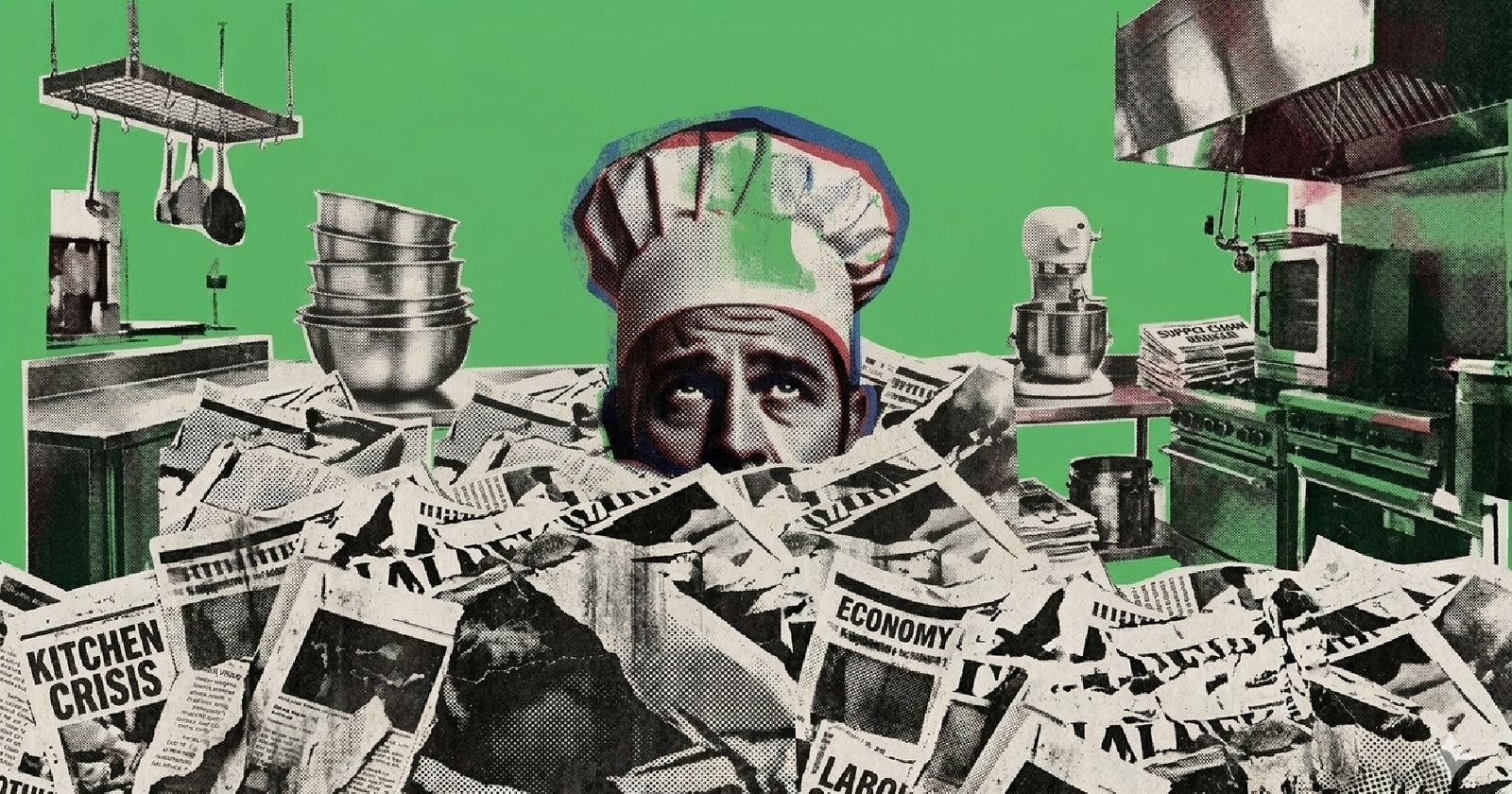

False stories have become a routine issue for many restaurants. | Restaurant Business image using AI
On Saturday, Feb. 7, a popular X account called Wall Street Apes posted that the CEO of Chipotle had been “caught on a recording” saying that the chain was going to raise prices because many of its customers come from higher-income households.
The post was reshared 12,000 times, sparking an outcry on social media and drawing negative headlines from outlets like Fox News and the New York Post.
There was just one problem: It wasn’t true. The post blatantly misconstrued Chipotle CEO Scott Boatwright’s actual comments, which were captured not on a leaked recording, but on a public earnings call with financial analysts held earlier that week.
Boatwright did say on the call that many of Chipotle’s core customers come from households earning $100,000 or more, and that the chain wanted to focus more on that group as it looks to drive traffic this year.
However, he said nothing about raising prices, on those customers or anyone else. In fact, CFO Adam Rymer said on the same call that Chipotle plans to keep price hikes below inflation in 2026.
Still, the idea that the chain was secretly planning to gouge loyal customers made for good social media fodder and juicy headlines.
It spread quickly over the weekend, and by Monday, the situation was firmly on the radar of Chipotle’s social listening team, a group of half a dozen staffers who monitor social media from 7 a.m. to midnight, tracking chatter about the burrito chain, be it positive or negative.
“In this case, it was clearly blatantly wrong,” said Laurie Schalow, Chipotle’s chief corporate affairs and food safety officer. “And we’re very sensitive to the pricing conversation and value for consumers these days. So that’s why we felt very quickly on this one that we needed to respond.”
That day, Boatwright set the record straight in a previously scheduled interview with Yahoo Finance. Schalow issued a separate statement to the press, and the chain’s social team worked to respond to inaccurate posts and comments that were gaining traction on social media.
Chipotle didn’t see a direct impact on its business from the episode, Schalow said, but it posed a threat to the brand’s reputation. “It was something we wanted to correct because it was not right,” she said.
It was just the latest example of how restaurants are increasingly finding themselves on the wrong end of the attention economy, where virality often trumps veracity and bogus stories can spread in the blink of an eye. For some restaurant PR teams, reining in false or misleading storylines has become a routine part of the job.
In just the past couple of months:
Cracker Barrel worked to corral a misleading narrative about its employee meal policy. A seemingly AI-generated news site called Earthlings 1997 reported that BJ’s Restaurants was filing for bankruptcy. (It is not.)A TikTok user claimed that Texas Roadhouse hides cameras in its overhead lighting. (It does not.) Former Chuck E. Cheese CEO David McKillips had to publicly deny rumors that he’d stepped down because his name was in the Epstein files. (It was, in an innocuous list of attendees of a business conference Epstein was also attending).
The idea of “fake news” is not new, but several factors have allowed it to flourish, including the dominance of social media, the rise of AI and the weakening of traditional media gatekeepers.
“I think what has changed is the velocity at which it comes at us,” said Elizabeth Jarvis-Shean, chief corporate affairs officer at DoorDash, which dealt with its own case of misinformation earlier this year. “The distribution channels are so much more available,” which is why it seems to be happening more frequently.
Indeed, the flashpoint for many of the above incidents is social media, where narratives, real or not, can quickly catch fire and cross over into mainstream news, podcasts, blogs and other outlets.
At the same time, social media is becoming a news source in its own right. According to the Pew Research Center, about 53% of Americans now get at least some of their news from platforms like Facebook, YouTube and TikTok.
The problem is that social media is not always a reliable source. Each person’s feed is algorithmically tailored to their own views and interests, enveloping them in an information bubble that may not reflect reality. On top of that, unlike in traditional news media, social media users are under no obligation to tell the truth.
“Other than shouting fire in a movie theater, I can kind of publish what I want,” said Jacqueline Babb, associate professor of integrated marketing communications at Northwestern University. “And so it is increasingly difficult to figure out as a consumer what’s true and not true.”
Adding another layer to the issue is the rise of artificial intelligence, which is fueling the creation and distribution of fake news.
“That probably feels like a real accelerant in the last six to 12 months, is AI as a way to hypercharge that velocity and distribute it to even more of those channels instantaneously,” Jarvis-Shean said.
“It seems like somebody makes an accusation, and it skips the traditional route of filtering by a news organization and immediately gets run.” —Travis Doster, Chief Communications Officer for Texas Roadhouse
At Texas Roadhouse, Chief Communications Officer Travis Doster is seeing more of all of it. He finds himself chasing down false stories almost daily, while AI-generated fakes have become a weekly occurrence.
In one recent example, a TikTok user named @zandermarlow posted a video from inside a Texas Roadhouse showing what he claimed was a camera in the light fixture above the table, “watching you eat.”
The possibly innocent but wildly misinformed post generated more than 3 million views and spilled over into some news outlets, drawing a denial from the steakhouse chain along with a detailed discussion of its lightbulbs:
“There are absolutely no cameras in any of the light fixtures in our restaurant,” the company said in a statement to the US Sun. “The lightbulbs we use are called ‘silver dome’ and are used to reflect light back into the fixture, reducing glare and softening brightness. We use them for guest comfort and ambiance.”
While that rumor started on social media, Doster said news sites will frequently pick up those rumors and publish them without checking whether they’re true first.
“It seems like somebody makes an accusation, and it skips the traditional route of filtering by a news organization and immediately gets run,” he said. Though the story may eventually be corrected, some readers will never see it.
“Now you have to fight every single negative or inaccurate narrative that’s out there, because if you leave it untouched, you risk having that cascade through other outlets, having that domino across social media, and you lose complete control, and you’re running to catch up.” —Liz DiTrapano, partner with ICR
It’s a challenging time for traditional media outlets. Fewer consumers are clicking on stories and visiting news websites, thanks in part to social media and the rise of AI-powered search engines and chatbots. From 2020 to 2025, average monthly traffic to the top 1,000 websites declined by more than 11%, according to data from analytics company Similarweb. The Columbia Journalism Review warned of a “traffic apocalypse” for online news.
This has led to newsroom layoffs, which places more responsibility on the shoulders of fewer journalists.
“They probably can’t take the time to fact check as much,” noted Schalow, which means restaurants have to be that much more vigilant about policing inaccuracies themselves.
The news industry’s struggles have also created an environment that incentivizes the sensational. Consider this headline from Time Out Worldwide: “Olive Garden is shutting down all of its 900 stores for 24 hours. Here is why.” Spoiler alert: It was for Thanksgiving and Christmas.
“I think there is a competition over where people are getting information, and you’re seeing a focus on speed and virality” from news outlets, said Liz DiTrapano, partner with ICR, a strategic communications firm that represents many large restaurant chains. “It’s just about getting it out there fast and being part of the conversation.”
While this might help news sites get more clicks, it also perpetuates inaccuracies, creating a snowball effect that can be difficult for brands to contain. This has kept PR professionals like DiTrapano on their toes.
“Now you have to fight every single negative or inaccurate narrative that’s out there, because if you leave it untouched, you risk having that cascade through other outlets, having that domino across social media, and you lose complete control, and you’re running to catch up,” she said.
That’s one reason why DoorDash moved quickly to stomp out any connection between itself and an accusatory Reddit post that began making waves online in early January.
The anonymous poster claimed to be a software developer at an unnamed third-party delivery app and alleged a number of questionable practices by the company. They said that the company referred to delivery drivers internally as “human assets” and assigned them “desperation scores” to calculate how little it could pay them to accept delivery trips.
DoorDash, which uses a host of social-media monitoring tools, noticed that the story was gaining momentum, especially on X. And though the post did not point to DoorDash directly, it “impugned the values and reputation of the industry as a whole,” said Jarvis-Shean. “And as a leader in the industry, if the industry is having its values questioned, that fundamentally is going to be about us.”
Within about 24 hours of the post going viral, CEO and founder Tony Xu denied that it was about DoorDash in a strongly worded X post. The company also published a more in-depth rebuttal on its website as a “source of truth” that people could refer back to.
It was soon revealed that the Reddit post was a hoax and likely written with the help of AI. But in the moment, whether it was real was beside the point, said Jarvis-Shean.
“It’s a little bit like if your house is on fire,” she said. “Maybe it’s because of an accident. Maybe it’s because of an arsonist. But your house is on fire. So you better grab a hose and a water bucket or whatever it is, and start trying to douse the flames. You can figure out who set the fire afterwards.”
“If people think the best of you, they’ll give you the benefit of the doubt. But if you have a poor reputation, they won’t.” —Jacqueline Babb, associate professor of integrated marketing communications at Northwestern University
Both Jarvis-Shean and Schalow of Chipotle are proponents of using software that can monitor social media and help brands gauge what people are saying about them online. Thanks to AI, these tools have become much more sophisticated over the past several years, said Jarvis-Shean.
“It’ll give you a much better sense of conversations … that may not name your brand directly or may not hit the keywords, but it actually is going to tell you, ‘Oh, this is something you should be paying attention to,’” she said.
On the PR side, DiTrapano said she has advised brands to be more proactive about engaging with the media, forging ties with reporters and getting out ahead of potentially harmful narratives.
“I think that goes really far in terms of building relationships with trusted media outlets that are going to get truthful stories out there,” she said. “They’re not always going to be positive, but they’re going to be accurate.”
Ultimately, restaurant brands can’t control what is said about them on social media, noted Babb, the Northwestern professor. What they can control is the experience they provide in their restaurants and how they treat customers and employees.
She offered the example of Jeni’s Splendid Ice Cream, which in 2015 learned that listeria had been detected in a sample of its ice cream. Though no illnesses were ever reported, the chain responded by closing its Columbus manufacturing plant and its 20 shops and recalling 265 tons of ice cream.
It cost the company millions of dollars, but it built trust with customers, who returned in droves when Jeni’s eventually reopened. Today, the chain has nearly 100 shops and saw sales growth of 16% in 2024, per Technomic data.
The message for restaurants: “If people think the best of you, they’ll give you the benefit of the doubt,” Babb said. “But if you have a poor reputation, they won’t.”
That has proven true for Texas Roadhouse, which has remained one of the strongest and fastest-growing restaurant chains in the industry despite what some people may mistakenly believe about its lightbulbs.
Doster said he hears from customers all the time who want to confirm something they’ve seen floating around online. They’re also looking out for the brand. One person wrote to Doster recently to tip him off about an Indiana doughnut shop selling “Texas Roadhouse doughnuts” made with the chain’s retail honey butter.
“People are helping protect us,” Doster said. “I think our operators have done a great job of building goodwill within their communities. And so a lot of times, even with the lightbulb story, people assume the positive about our stores.”