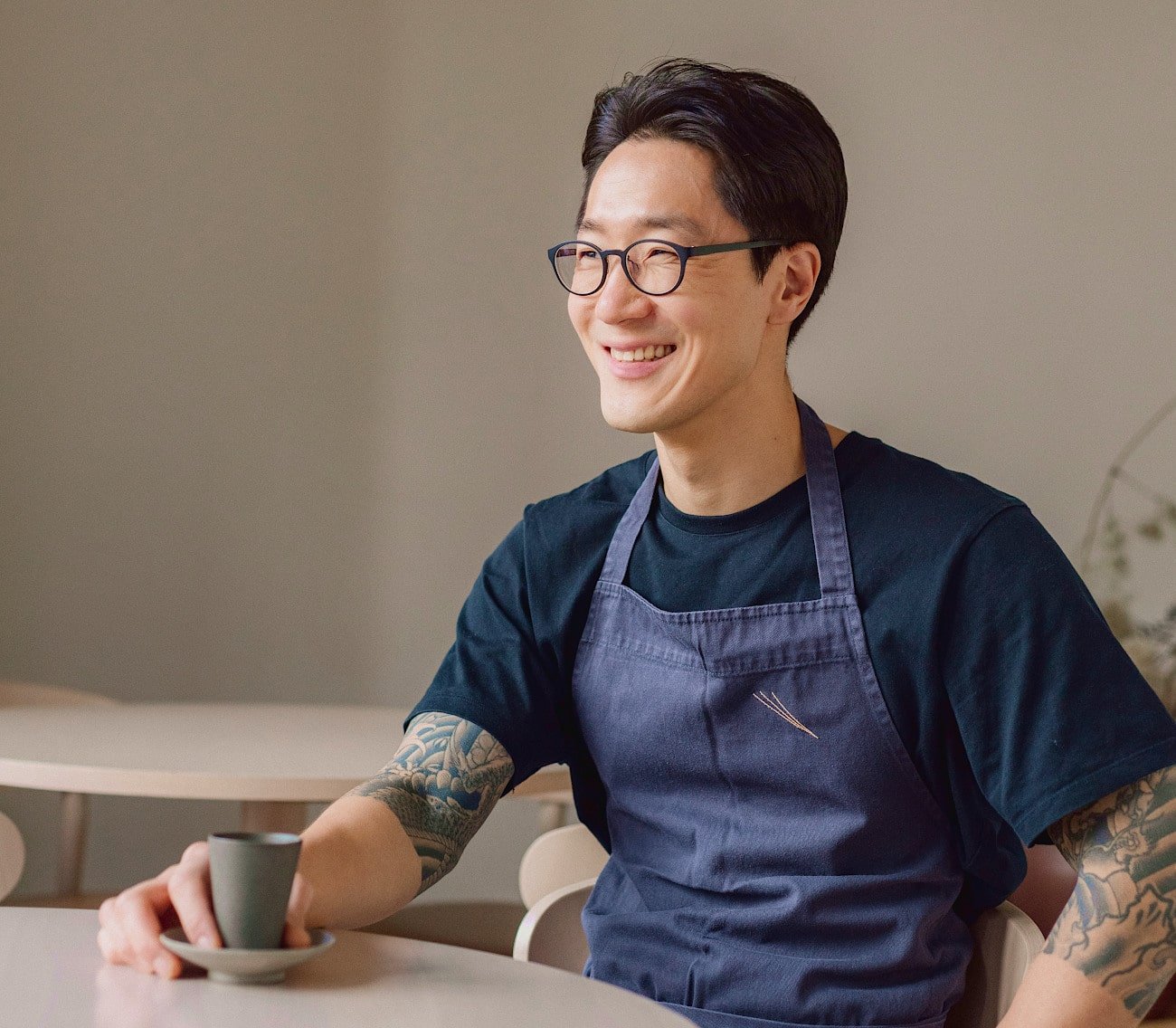

Chef Woongchul Park, co-founder of Sollip, is one of the most compelling voices in London’s modern fine dining scene. Together with his wife and pastry chef Bomee Ki, he has built a restaurant that seamlessly blends Korean heritage with French technique and British seasonal produce, earning a Michelin star and widespread critical acclaim.
Before opening Sollip, Park trained in some of Europe’s most refined kitchens, developing a style rooted in precision, restraint, and quiet depth. His cooking is defined not by overt fusion, but by a thoughtful integration of influences shaped by his journey between Korea and London.
At Sollip, that philosophy translates into dishes that are understated yet deeply expressive where fermentation, time, and technique work behind the scenes to create food that is both personal and refined.
1. Your culinary journey spans Korea and Europe, with experience in some of the world’s most refined kitchens. How did those contrasting cultures shape your identity as a chef before opening Sollip?
I believe that food with one’s own unique touch is ultimately created through personal experiences, not just as a chef but as a person in life. When I reflect on this, both of us studied French-based cuisine and desserts, and we built our careers in related fields.
As we gained experience traveling between London and Korea, our food became influenced not only by French cuisine but also by British and European influences. And, as Koreans who grew up with Korean food, I believe that influence naturally comes through as well. Rather than drawing inspiration from something specific, I believe that our experiences and identities as people and chefs naturally show in our food and space.
2. Korean cuisine is deeply rooted in fermentation, preservation, and time. How do these traditions inform your cooking at Sollip, even when they aren’t immediately visible to the guest?
I feel that the practice of waiting, whether for fermentation or preservation, is something quite commonly found everywhere now. At Sollip, we also preserve and ferment various seasonal ingredients, as well as our own jang and sauces, embracing the long wait for each specific purpose.
However, we don’t feel the need to overtly showcase or highlight these processes on the surface. We believe that the quiet time and affection invested behind the scenes naturally add depth and weight to the dish, and we trust that our guests will be able to feel that sincerity when they eat.

3. Is there a dish on the current menu that best represents Sollip’s philosophy right now—and why?
The Daikon Tarte Tatin, one of our signature dishes. It was the very first recipe we began developing and has remained on the menu since day one, a dish that’s quietly evolved over time but never disappeared. It’s something we feel deeply attached to.
I wanted to reinterpret the classic French tarte tatin as a savoury dish using one of the most humble and familiar Korean ingredients, daikon. A core part of everyday Korean cooking, it felt like the right place to start when thinking about how to express our identity and direction through food.
The idea originally began with daikon or Korean cabbage, Baechu, ingredients central to Korean cuisine. But after much thought, we recently reimagined the dish in a completely different way. With the help of my wife, our pastry chef, we refined the concept over many trials to find the right balance of texture and flavour in a way that felt true to Sollip.
Thin slices of daikon are salted, pressed, and layered into the tarte, finished with puff pastry and topped with roasted barley, garlic paste, and a glaze made from aged kimchi. It’s served as a clean, focused slice alongside a soubise-style sauce made with onion, rice, and makgeolli lees.

4. Sollip is a partnership in every sense, with Bomee leading the pastry and front-of-house. How does her background as a pastry chef influence the way you approach the savory side of the menu? Do you find your flavors bleeding into each other’s work?
Beyond cooking and food, my wife and I share a deep alignment in our sense of aesthetics, values, and future direction, which makes it easy to trust each other’s decisions. For me especially, it’s not simply because she’s my wife. Having worked closely with Bomee for many years, I know firsthand how she approaches her work and solves problems at the core. That deep understanding naturally leads to trust and respect, and I often rely on her judgment even more than my own.
In the kitchen, we rarely experience conflict. I would say about 95 percent of the time we are fully in sync. This is largely because our personalities, tastes, and the kind of cuisine we pursue as chefs are remarkably similar, leaving little room for disagreement. When one of us struggles or slows down, the other naturally steps in to support or push when needed, and that balance has become one of our greatest strengths.
If challenges arise, they tend to come from outside the restaurant, especially when it comes to raising our children, where our different upbringings and perspectives sometimes clash. But we continue to communicate, adjust, and grow together over time. Of course, like any couple, we do argue now and then.
5. Seasonality plays a central role in your menus. How do you approach Korean flavours through the lens of British produce without losing their cultural identity?
To be honest, I don’t make a conscious effort to “protect” or enforce a Korean identity in my flavours. While it varies from dish to dish, I don’t have an obsession with the idea that British produce must be dressed in Korean flavours. As I mentioned before, I believe a chef’s cuisine is a natural evolution of their experiences, both as a professional and as a human being, moving toward their desired direction.
I don’t have an obsession with the idea that British produce must be dressed in Korean flavours.
My career and life’s journey will naturally manifest in my cooking. Therefore, my focus is simply to express that journey in an organic, non-artificial way, using the exceptional seasonal produce available here in Britain.
6. Since opening, have you noticed London diners becoming more literate in the nuances of Korean ingredients beyond the well-known staples like Kimchi and Gochujang?
There are those who understand it deeply and those who don’t, but I often wonder, is total understanding really necessary? If you encounter any food often enough, you become familiar with it, and familiarity often leads to genuine enjoyment. Just as we can’t assume every Korean has a profound understanding of Korean cuisine and every ingredient, I think having an interest and frequent exposure is more important than “literacy.”
One of the main reasons I love London is that diners here are incredibly open-minded toward things they haven’t experienced before. They approach the new without prejudice. I strongly feel that they accept our food for what it is and appreciate it without fixed ideas.
7. Running a Michelin-starred restaurant comes with immense pressure. What have been the biggest challenges of maintaining consistency and creative momentum at this level?
It is incredibly difficult, yet essential, to set a high personal standard and maintain it without wavering. The true challenge is not so much achieving a star as it is consistently delivering that same level of quality every single day. Because we are never satisfied with where we are and always have the ambition to push our standards higher, we must embrace and overcome the daily pressure that comes with it.
Furthermore, I believe that creativity originates from a sincere and consistent mindset. When you stay true to the basics and remain dedicated to your routine, that is when genuine inspiration finally finds its way to you.
8. What’s something diners might not fully realise about the amount of preparation or discipline required behind a single Sollip service?
Whether guests notice it or not, we are obsessed with the very small details based on our own standards. Also, for that one meal our guests enjoy, our team comes in to prepare much earlier and stays much later than people might think. Behind the scenes, there is a lot of hard work and time invested by the whole team to make sure everything is ready.

9. Fine dining is often shaped by trends. Is there a current trend in modern restaurants that you feel has run its course—or one you’d like to see quietly fade away?
I feel we could afford to step back from excessive garnishes used purely for show, forced combinations created solely for the sake of “unimaginable” ideas, or overly complex and artificial storytelling. At the end of the day, the essence of cooking is flavour. I believe a restaurant’s true purpose is for the entire team to work together to deliver delicious food that reflects their unique identity, paired with sincere service, to give guests the greatest possible happiness during their time with us.
I feel we could afford to step back from excessive garnishes used purely for show, forced combinations created solely for the sake of “unimaginable” ideas, or overly complex and artificial storytelling.
Therefore, I think we should move away from long-winded explanations or styles where the focus isn’t on the guest’s enjoyment of the meal, but rather on technical displays or other external elements.
10. Looking back, was there a particular moment, dish, or decision that marked a turning point in your career?
I’m not the type of person who makes a big deal out of things, so there isn’t one specific dramatic moment that comes to mind. But if I had to choose, it would be the process of moving to London with my family and deciding to open Sollip. Since the opening, I have become a business owner responsible for my staff, not just a chef. That sense of responsibility has changed my attitude toward life and helped me grow in many ways.
11. For home cooks inspired by Korean flavours, what is one principle or technique that can dramatically improve their cooking?
I suggest thinking more deeply about how to use Jang. Soy sauce or soybean paste are not just tools for seasoning. They play a key role in building layers of deep umami at the base of a dish. Depending on whether you add them at the beginning or the end of cooking, and how you use them, the depth of flavour changes completely.
12. What advice would you give to young chefs who want to work at the level of modern fine dining you represent?
It is very important to have the patience to accept the daily routine and the hard work that comes with it. You must also have an attitude of truly valuing your ingredients and your guests. I believe this mindset and a strong foundation should be built carefully from the very beginning.
The profession of a chef has a low entry barrier, but the road to success is narrow, long, and difficult. That is why you need the right attitude and inner strength to endure the journey.
13. Beyond the Michelin star, what is the most rewarding feedback you’ve received from a guest that made you feel you had truly achieved what you set out to do?
I’m not sure how much feedback other chefs receive, so it’s hard to compare, but I feel we are very lucky to get so much wonderful and moving feedback. Some say it was the “best meal of their life,” and one person even said it was “better than my grandmother’s cooking.”
But the most memorable moment happened about three weeks ago. A guest in a couple started crying because our main duck dish was so delicious. It wasn’t just a few tears, she was truly sobbing and kept saying thank you. I was a bit surprised at first, but it was an incredibly happy experience for me. I wondered, how many chefs in their lifetime get to meet a guest who cries out of pure happiness because of their food?
14. Finally, when people talk about Sollip and your work ten years from now, what do you hope they remember most about its contribution to London’s dining scene?
I hope we are remembered as a place that was “quiet but solid.” A place that didn’t chase trends but silently protected its own clear identity. I want Sollip to be seen as a place that proved how gracefully Korean sensibilities can blend into London and the UK. I also hope to be remembered as a chef who represents Korea in the UK.
Chef Woongchul Park | Instagram
Sollip
Unit 1, 8 Melior St, London SE1 3QP, United Kingdom