
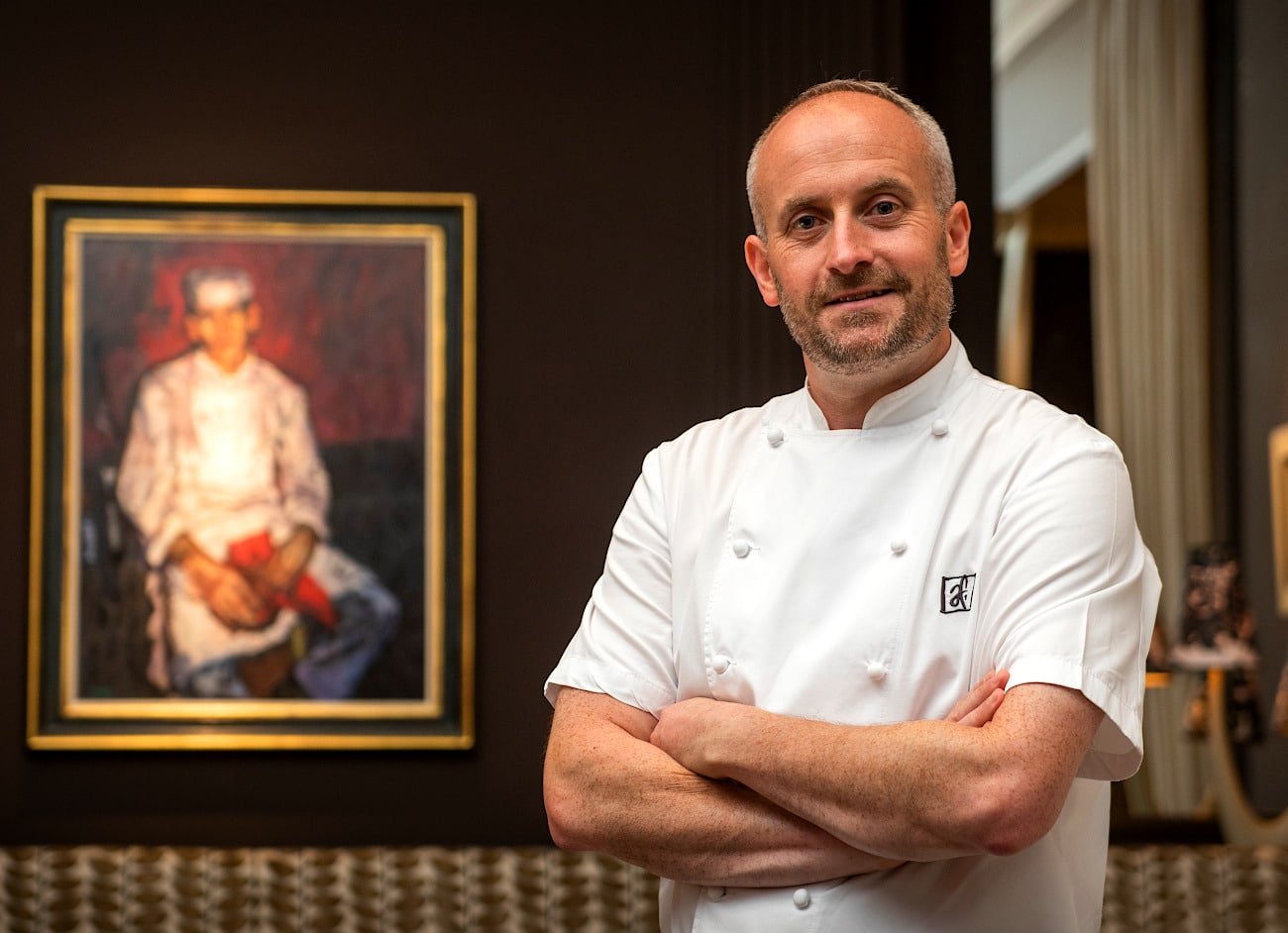

I think this is a really interesting change that reflects the current climate – there’s been a real shift in chefs wanting to look after themselves better and eat more healthily, and this naturally feeds into the menu.
5. Produce has always been central to Restaurant Andrew Fairlie. Is there a Scottish ingredient or supplier that continues to inspire you or challenge you creatively?
I used to think I was biased as a Scot, living and working in the heart of Scotland, but I’ve grown to realise I’m not biased, it’s the truth: Scotland is home to some of the best produce in the world. And I don’t just mean the world-famous shellfish, but the vegetables, wild mushrooms and game in season too. For example, Scottish asparagus is perfect. We can have it picked fresh in the morning specifically for us, ready to be served in the evening, and we barely need to do anything to it. It just needs to be cooked and seasoned properly and served at the right temperature to let that beautiful flavour shine through.
At Restaurant Andrew Fairlie, one of the challenges we set for ourselves is to find a new supplier every year. Our most recent find is one we have fallen in love with: Rachel Cratchley. Rachel has a dairy farm in Auchterarder, just eight miles from the restaurant, with a herd of eight Friesian cows that produce a very small amount of world-class Jersey milk. For the last year we’ve been using Rachel’s milk to make our milk ice cream, which is a 25-year-old recipe and one of our favourites. Rachael’s milk makes our recipe better! It’s phenomenal – it has a deep richness, it’s full of character, and it tastes of Scotland!
6. Holding two Michelin stars for 21 consecutive years is a feat of incredible consistency. What is the daily “Andrew Fairlie” standard that you instil in your team to ensure that the quality never wavers, regardless of the pressure?
The daily standard we’re striving for is to make sure our guests have the best dining experience they’ll ever have. But the important thing that we instil in the team is that there is no pressure. We have a great deal of responsibility as individuals and as a team, but we don’t have pressure.
We’re working to deliver what Andrew set up for us – it’s his, not ours. So, it’s our responsibility to retain and extend his legacy, but I never want the team to feel pressure.
7. What’s something diners might not fully realise about the preparation, discipline, or repetition required to deliver a single service at this level?
I think the thing that surprises people when they see our kitchen and meet the team is the calmness and quiet that we have behind the scenes.
We believe in the importance of working in a very organised and calm environment, where people can think and hear clearly. We cook and work with all our senses, so we need to be able to smell, see and hear what’s happening in the kitchen, as well as tasting our way through a service in all the different sections.
8. Fine dining is constantly evolving. Is there a trend in modern gastronomy that you feel has run its course, or one you’re consciously choosing not to follow?
The ’trend’ that I think, or hope, has run its course is the old school kitchen culture – kitchens that are aggressive and testosterone-fuelled, where people can’t develop. This is something that we have always chosen not to follow, and I very much hope is something of the past.
People need to be able to work comfortably, confidently and feel relaxed, as well as being properly looked after and developed. We want to see shoulders back and heads up, not people feeling intimidated.
9. How do you approach mentoring young chefs within the kitchen, especially in an environment so closely associated with excellence and tradition?
This stems back to my days before I was even a chef, when I was given an opportunity to achieve something. I always take that into consideration when we’re recruiting. Everyone deserves an opportunity, but it must be met with commitment, focus and passion from both sides.
Mentoring young chefs is something I feel incredibly strongly about. I’ve deliberately freed up some of my time as part of my own development and focus over the last few years, to spend time with the young people in the kitchen and in our industry. It’s about making sure that they’re using the right knife for each job but also helping them to source good quality knives for themselves. It’s also important to teach them about seasoning and helping them to understand the power of salt, as well as teaching them how to properly taste and to learn and trust their palete. It’s amazing when you go into this depth of detail with a young chef and you can see the spark in them come alive.
This mentoring is something I’m expecting our senior brigade to follow with too. To become good mentors and leaders is a big part of becoming a great chef. And it’s an honour to play a part in the successful careers of some phenomenal chefs, as well as inspiring a love of what we do at Restaurant Andrew Fairlie in others.
10. What have been the biggest challenges of maintaining consistency, focus, and morale within the team?
As with many restaurants and businesses, going into and coming out of the Covid-19 pandemic was tricky, as everybody’s life changed. The restaurant was obviously closed for extended periods of time, and for the first time our team wasn’t together as they were spread over the UK and Europe. Keeping in good contact with people and engaging with how they were personally was very difficult. At work our contact is very close, so to have it gone was a big thing for us.
When we could finally bring the team back, we had lost some people who had found new vocations – so we had to find suitable Restaurant Andrew Fairlie replacements to fill their chef whites. The same happened with suppliers in many ways, as some of our suppliers had to diversify and change their produce. So, we didn’t automatically click back into the old work life, and we weren’t coming back with the same team or supply chain. This was a challenge for us, when consistency is so important to what we do. But we accepted the changes and learnt to work slightly differently, which has proven successful for us.