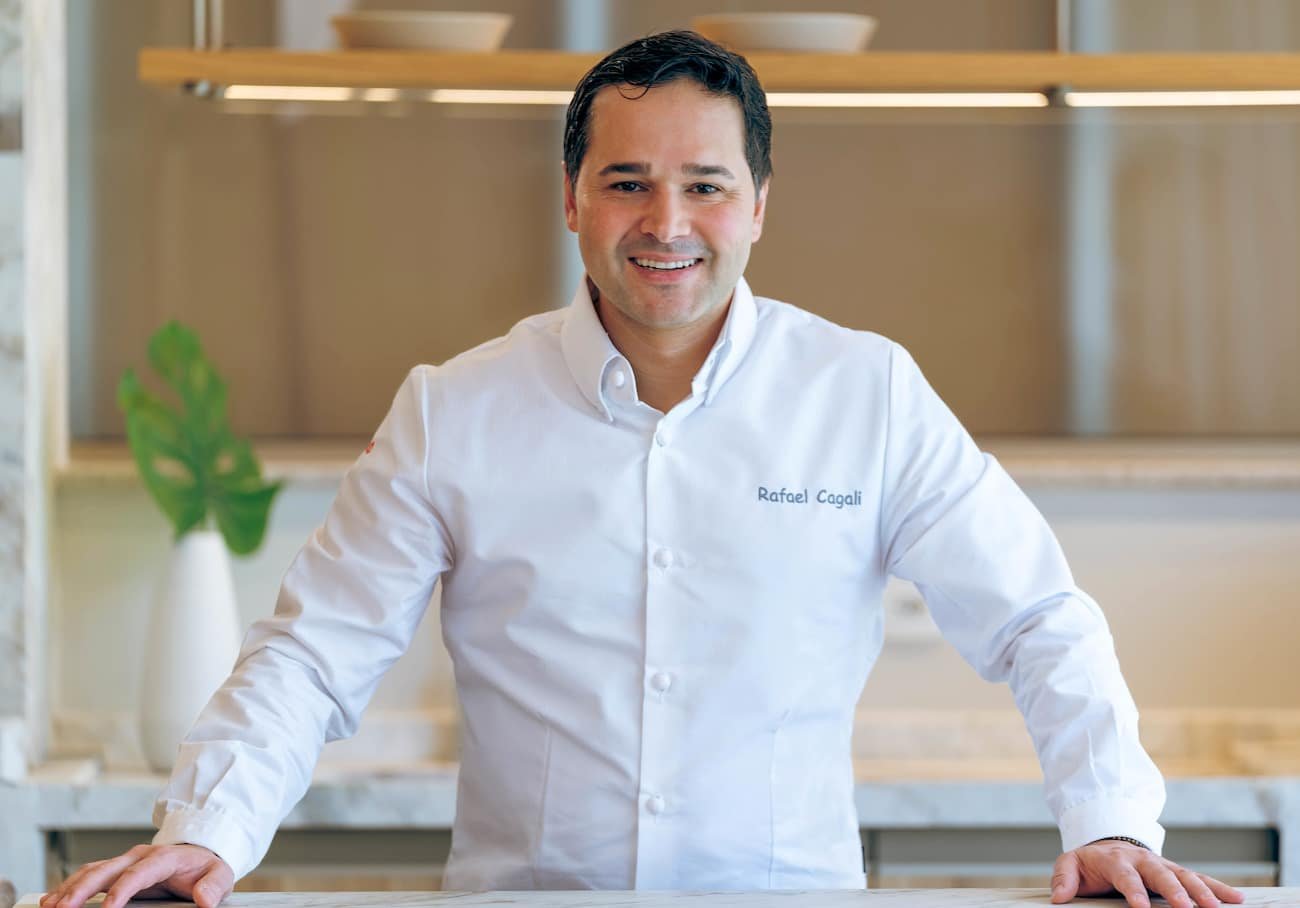

Few chefs in London’s fine-dining scene embody global perspective and technical mastery as completely as Rafael Cagali. Born in Brazil and shaped by formative years in Italy, Spain, and some of the UK’s most influential kitchens—including The Fat Duck and Fera at Claridge’s—Cagali has built a deeply personal culinary voice at Da Terra, one of the capital’s most acclaimed restaurants. Since opening in 2019, Da Terra has earned two Michelin stars and international recognition for its refined, emotionally grounded approach to modern tasting menus.
In this exclusive interview with Chef’s Pencil, Chef Cagali reflects on the journey behind his distinctive cooking philosophy, the cultural influences that define his work, and the discipline required to sustain excellence at the highest level of contemporary gastronomy.
1. Your culinary background spans Brazil, Italy, Spain, and some of the most prestigious kitchens in the UK, including The Fat Duck and Fera at Claridge’s. How did these diverse influences come together to form the singular vision behind Da Terra?
My career has been a process of accumulation rather than replacement. Brazil gave me instinct and the memories from my country are a solid base I built on. Italy taught me discipline and great respect for ingredients. Spain was an eyes-opening experience. And the UK refined my understanding of precision and consistency in everything I do.
Da Terra is where all of those elements coexist. It’s more about filtering all those influences through my own identity and expressing them in a coherent and deeply personal way.
2. Beyond your Brazilian roots, you also have a strong Italian heritage. In what subtle ways does Italian technique or philosophy influence the backbone of your cooking at Da Terra?
Italian cooking is blended in the way I think about food, starting with the idea that simplicity requires more skill than complexity. At Da Terra, that often means applying moderation – knowing when to stop, when not to add another element, and trusting great produce to speak for itself. There’s also a strong
At Da Terra, that often means applying moderation – knowing when to stop, when not to add another element, and trusting great produce to speak for itself. emphasis on balance and comfort, even in fine-dining contexts.
3. You’re often credited with bringing a sophisticated Latin American influence to the London fine-dining scene. How do you balance the vibrant, often rustic memories of Brazilian flavours with the precision and restraint required of a two-Michelin-starred kitchen?
For me, sophistication doesn’t mean making something weaker. The emotional core of Brazilian food (acidity and warmth are key words for me to describe it) remains intact, but it’s expressed through a more controlled lens. Precision allows those flavours to be clearer, not quieter. The challenge is to honour memory while using technique thoughtfully, so nothing feels nostalgic for nostalgia’s sake.

4. Da Terra famously offers a blind tasting menu. What is the intention behind this element of surprise, and how does it change the way diners experience flavour?
The blind menu removes expectation. Without visual cues or preconceived ideas, guests engage with flavour in a much more instinctive way. It encourages curiosity and trust. It’s not about tricks: for us, it was the best way to put flavour first.
5. Is there a dish on the current menu that best represents your cooking philosophy right now – and why?
That’s an interesting question, as it changes from time to time. Right now, it would be a dish that looks restrained but reveals layers as you eat – something that rewards attention. That’s where my cooking is at the moment: depth without excess. The dish I am thinking of right now is the Tortellini in Brodo – they are part of the Quail course.
6. You place a high premium on British produce. Is there a UK ingredient or supplier that has significantly influenced your current seasonal menu?
British produce is at the heart of the menu. I’m particularly inspired by small growers who work with heritage varieties and aren’t afraid of seasonality dictating availability. We work closely with the likes of Henderson’s Fishmongers in Cornwall, farmers from the Lake District, and Wiltshire Truffles. They really know their stuff and respect the seasons, which pushes us to get creative.
From Brazil, we love small-scale suppliers like Weber Haus Cachaça, made by a family since 1948, and the traditional dendê oil from Bahia, hand-pressed using old Quilombolan methods.
It’s all about great ingredients and people who care.
7. Running a restaurant at the highest level comes with intense pressure. What have been the biggest challenges of maintaining both consistency and creativity at Da Terra?
Consistency is about systems and people; creativity is about space and trust. The challenge is protecting both. You need structure to deliver at a two-star level every night, but you also need an environment where ideas can evolve. I believe we are trying to put as much attention (and a good dose of humility too) in achieving both: the team is the starting point.

8. What’s something diners might not fully realise about the preparation behind a single two-star service, especially today?
Every service represents days – sometimes weeks – of preparation, testing, and refinement. In the current economic climate, doing that while maintaining quality, supporting staff, and staying sustainable is increasingly complex. What arrives on the plate is only a small part of the work that goes into it.
Every service represents days – sometimes weeks – of preparation, testing, and refinement.
9. Is there a fine-dining trend you feel has run its course?
Trends that prioritise spectacle over substance rarely age well. I hope we continue moving away from excess for the sake of attention and back toward cooking that feels intentional and grounded.
10. Looking back, was there a turning point in your career?
Opening Da Terra was the defining moment, for sure. It was the first time my real voice came through, no filters. That responsibility was terrifying, and transformative at the same time.

11. You reached two Michelin stars relatively quickly. What does success look like to you today?
Success now is longevity. Creating a restaurant that evolves, supports its people, and remains relevant without chasing validation. Personally, it’s about balance and integrity, being proud of the work while staying curious.
12. One “pro move” home cooks can use to elevate a dish?
Season gradually and taste constantly. Most dishes don’t need more ingredients, they only need a better balance.
13. What advice would you give to young chefs aspiring to this level of fine dining?
Be patient and resilient. Learn fundamentals before chasing creativity, and remember that cooking at this level is a marathon, not a sprint. Protect your curiosity, it’s more valuable than speed.
14. When people talk about Rafael Cagali and Da Terra ten years from now, what do you hope they remember?
I hope they remember honesty, that the food was personal, thoughtful, and respectful of its roots, and that Da Terra contributed something meaningful to the UK’s culinary conversation rather than simply following it.

Chef Rafael Cagali | Instagram
Da Terra
8 Patriot Square, London E2 9NF, UK