
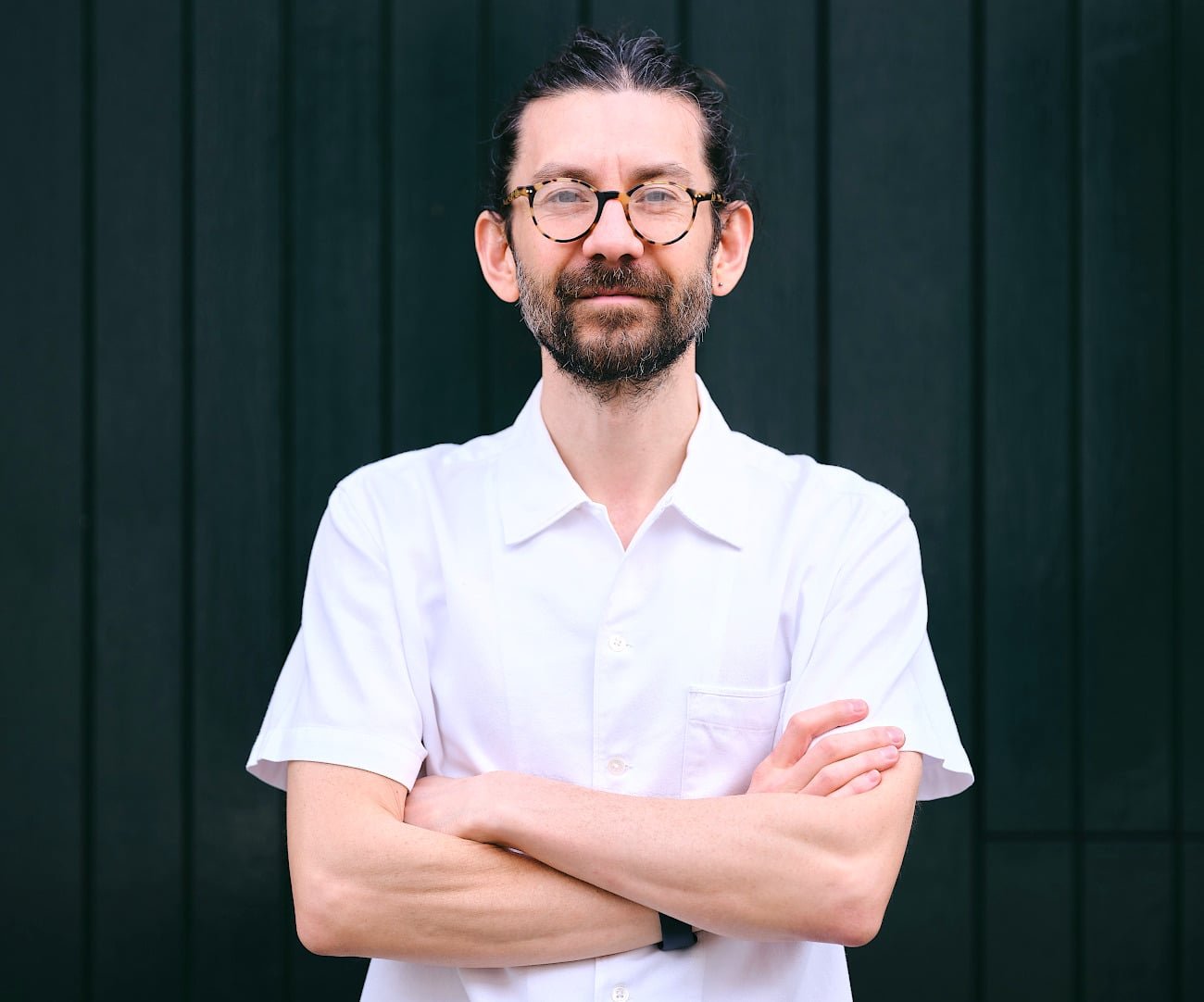

Exceptionally thoughtful, quietly innovative, and deeply rooted in both heritage and place, John Chantarasak has become one of the most distinctive voices in London’s modern dining scene. At AngloThai, his acclaimed Marylebone restaurant, Chantarasak reimagines Thai cuisine through a British lens—pairing bold, balanced Thai flavour profiles with the best seasonal produce the UK has to offer.
Shaped by years of study in Thailand, time spent cooking alongside his late grandmother, and a long journey through pop-ups before opening his permanent home, Chantarasak’s cooking is driven by precision, memory, and a deep respect for tradition. From freshly pressed coconut cream to house-made ferments and garums, every detail at AngloThai reflects his uncompromising approach to flavour and craft.
In this exclusive Chef’s Pencil interview, John Chantarasak opens up about the origins of AngloThai, adapting Thai cuisine to British terroir, building a sustainable independent restaurant, and the personal experiences that continue to shape his cooking—offering rare insight into one of the UK’s most original culinary minds.
1. You’ve described your cooking as “British ingredients through a Thai lens”. When you were first developing this concept, was there a specific lightbulb moment—or a particular dish—that convinced you British produce could stand up to the heat and acidity of Thai flavours?
There were two key moments I can trace back to the early conception of AngloThai. The first wasn’t exactly a single moment, but rather a collection of experiences cooking and conversing with my late grandmother in Thailand when I was living in Bangkok in 2014, while studying at Le Cordon Bleu and working at Nahm. Often, on my days off from studies and work, I would observe her cooking, trying to learn a handful of our family recipes and develop a deeper understanding of Thai cuisine from the best cook in our family.
During these times, we would often chat about food, and I remember something she mentioned that really stuck with me. She suggested that if she were based in another country and cooking Thai food, the ethos of the cuisine would still guide her to cook with local and seasonal produce. It’s not so much about the specific ingredients, but about finding and balancing the core flavour profiles—sweet, salty, spicy, and sour.
The second moment came a year later, when I cooked my first pop-ups with my dear friend Nicholas Balfe at his now-closed restaurant, Salon, in Brixton Market. At that first event, he suggested swapping out some Asian ingredients for those found closer to home—sea buckthorn for acidity, horseradish for spice, and honey for sweetness. It was during that first pop-up that AngloThai was really born, and since then I’ve focused my energy on developing this style of cooking.
2. Thai cuisine traditionally relies on ingredients like coconut milk, lime, and palm sugar, which don’t grow in the UK. How have you adapted your cooking—using alternatives such as sea buckthorn for acidity or rapeseed oil for richness—without losing the soul of Thai flavour?
As mentioned, Thai cuisine hinges on a few core flavour profiles—sweet, salty, spicy, and sour—which can be found beyond the ingredients traditionally associated with Thailand. For example, we derive sourness in our cooking from rhubarb, gooseberries, and verjus, as well as by making our own flavoured vinegars. Sweetness comes from local artisan honey. Spice comes from British-grown chillies, which we preserve during the summer months when they are abundant, allowing us to use them throughout the year. Saltiness comes from our own salt-based products, such as garums, soy sauces, and, of course, domestically produced salt.
We also now work closely with British farms to grow ingredients such as holy basil, lemongrass, and ginger for us. It’s still early days on that front, but over time we hope to become largely self-sufficient using UK-grown produce. For ingredients more traditionally associated with Thai cuisine—such as shrimp paste, coconuts, and citrus—we do still import some of them, but we work as closely as possible with artisanal farms in Thailand and closer to home to ensure everything we bring to the UK is of the highest quality.
Our shrimp paste comes directly from a farm in Krabi, in southern Thailand, and we import coconuts from overseas, as cracking the nuts and pressing our own fresh cream is a core part of the cooking we want to showcase at AngloThai. Fresh coconut cream is far superior to shop-bought versions, as it hasn’t been altered with stabilisers or preservatives. Of course, coconuts aren’t grown in the UK, but they are one of the few ingredients we consider essential to the cuisine, and in those cases, we allow ourselves the luxury of importing.
3. Growing up with both British and Thai heritage, how do you navigate the line between innovation and tradition? Are there any family recipes or flavour memories you consider untouchable?
I try to keep this as natural as possible. I’ve devoted more than a decade to researching, cooking, and travelling in Thailand, not to mention visiting the country every year of my life before I turned to professional cooking. Through these experiences, I’d like to think I’ve gained an understanding and respect for the cuisine and culture that define what should be considered traditional in my cooking style, however experimental or contemporary my approach may be. There are certain rules and structures within cuisines that should be respected and adhered to.
This isn’t exclusive to Thailand, but applies to cuisines around the world. For example, you can’t think of a dish as a green curry if you lose the fundamental backbone of its origin—starting with a fresh green chilli paste cooked out in coconut cream. Once that foundation is in place, you can begin to veer off-piste, because the identity of the original dish will always remain part of the cooking.
This all takes time and experience with a cuisine and isn’t something that can be rushed. I’m constantly returning to Thailand to continue my studies of its food and culture, while also pushing myself to uncover things I haven’t experienced before that might inform future dishes at AngloThai.

4. AngloThai spent years as a series of pop-ups before opening its permanent home in Marylebone. How has having a fixed kitchen changed your cooking—are there techniques or processes that simply weren’t possible before?
I was very fortunate that during my years of pop-up events, I was able to gradually build a well-equipped commercial-style kitchen at home, where I prepared for events and spent time cooking and developing dish ideas. By the time we came to open AngloThai, my home kitchen was at a stage where I, along with some of the senior chef team, could practise and refine the dishes that would form the opening menu.
Having access to a full commercial kitchen and, more importantly, an amazingly talented and passionate kitchen team, has pushed the food to new heights.
That said, having access to a full commercial kitchen and, more importantly, an amazingly talented and passionate kitchen team, has pushed the food to new heights. We’ve been able to fit in a significant amount of equipment, giving us great flexibility in how and what we cook. This includes a coconut press imported from Thailand for freshly pressing coconut cream, a turbo jet wok burner that takes our stir-fries to the next level, and a metre-wide charcoal grill.
5.Is there a signature dish at the restaurant right now that best encapsulates the evolution of AngloThai from its early days to today?
I don’t want AngloThai to be defined by a single dish, but there is one dish that hasn’t left the menu since we opened, and before that, it appeared in various forms during our pop-up events in the three years leading up to the opening. That dish is centred around three core ingredients: crab, caviar, and coconut. Each element is prepared in several ways to highlight both the versatility of Thai cuisine and the creativity of our cooking at AngloThai.
I don’t want AngloThai to be defined by a single dish.
The dish is loosely based on a Thai chilli dip called Lon Bpu (crab with coconut cream), found in central and southern Thailand. Lon is a rich relish made by simmering ingredients in fresh coconut milk, then seasoning it to the desired flavour profile with elements such as fish sauce, citrus juice, and sugar. Traditionally, it is eaten with various crudités, which are used to scoop up the relish, creating contrasting flavours and textures. In our version, the crab and caviar are paired with a traditional lotus-shaped cracker (Khanom Dtok Jok) stained black with coconut ash powder.
For me, this dish perfectly captures what we do best at AngloThai. The flavours, techniques, and ingredients reflect those found in Thailand, but the final result is an interpretation that is unique to our concept and restaurant. We serve it after our opening snack course—essentially as a snack in its own right—designed to invigorate and tantalise the palate with its combination of rich and fresh flavours.
It’s a dish we’re incredibly proud of, combining bold flavours and precise technique with striking presentation, while staying true to our ethos of working with the best-quality ingredients we can source.
6. Your wife and co-founder, Desiree, leads the wine programme with a focus on low intervention and biodynamic wines. Thai food is famously challenging to pair with wine—how do you collaborate to balance spice, acidity, and nuance on the table?
Desiree is highly knowledgeable about Thai cuisine through our continued travels and time spent across the country, as well as the hundreds of pop-up events and dishes that came before we opened our permanent site. We regularly taste the food and wine together with our kitchen and sommelier team, creating an open dialogue about which wines work best with each dish. The approach at AngloThai is very collaborative, and there are never any wrong questions or answers.
We favour white wines with texture, floral notes, and freshness, as well as lighter reds with prominent fruit and low tannins.
Desiree also has a deep love for wines from cooler European climates, particularly Austria, where indigenous grapes such as Müller-Thurgau, Grüner Veltliner, Welschriesling, Zweigelt, and Blaufränkisch pair beautifully with our food. We favour white wines with texture, floral notes, and freshness, as well as lighter reds with prominent fruit and low tannins. These are the wines we not only enjoy pairing at AngloThai, but also love drinking when we’re relaxing at home or dining out.

7. AngloThai places strong emphasis on ethics and sourcing. Beyond choosing the right producers, how are you managing food waste in the kitchen—are you using trims or “scraps” to build flavour through stocks, ferments, or sauces?
Sustainability is a pillar of our business and a core part of our cooking ethos at AngloThai. In many ways, this mentality is deeply rooted in Thai culture, where people are highly resourceful with the ingredients available to them, often shaped by limited wealth and modest living conditions. As a result, there is a strong tradition of using ingredients to their fullest.
We have recently completed our first year at the restaurant, which has helped deepen the kitchen’s understanding of domestic seasons and the rhythms of the small-scale farms we work with.
We are now in a stronger position to plan which key seasonal ingredients we want to preserve throughout the year through pickling, salting, smoking, and fermenting—whether it’s citrus and rhubarb in January and February, wild garlic and asparagus in spring, elderflower in early summer, stone fruits in late summer, or British chillies throughout the summer. This approach helps us build a flavour catalogue that we can draw on during quieter months, allowing us to continually develop deeper complexity in our dishes.
We also make a conscious effort to use waste products in multiple preparations to ensure we maximise every ingredient that passes through the kitchen. We coconut-smoke fish frames to make Pla Krob, which adds umami to sauces and stocks. Vegetable scraps and peels are turned into treacle for glazes and marinades, while spent coconut pulp becomes a sweet smoke mix that we throw directly onto hot coals to impart coconut flavour to grilled meats and vegetables.
These are just a few of the in-house projects through which we transform food waste into flavour-building components for our larder. In addition, many of these by-products form the backbone of our cocktail programme in collaboration with Mr Lyan, using zested makrut limes, spent coffee beans, and flavoured vinegars to give new life to ingredients that would otherwise be discarded.
8. London is currently experiencing something of a golden age for regional Thai cooking. Where do you see AngloThai fitting into this wider landscape?
The last decade has been an incredibly exciting time for Thai food in London. The introduction of Som Saa and Smoking Goat opened the door to a more regional and authentic side of Thai cooking that had rarely been seen since David Thompson closed Nahm in 2012. I believe interest in Thai cuisine has always existed, but the opening of those two restaurants in late 2014 ignited the next phase of the scene, inspiring places like Singburi, Kiln, and Farang, all of which brought a modern Thai ethos to their cooking.
More recently, with JKS opening Plaza Khao Gaeng and Speedboat Bar, the Thai food scene has continued to grow stronger and more diverse.
I don’t think AngloThai could have existed in its current form without the work these restaurants have done over the past decade to expand public perception and understanding of the cuisine. I believe we are now on the cusp of another very exciting decade for Thai food in London.
I’d like to think we work differently from other Thai restaurants in the city. While many strive for authenticity in a traditional sense, we find ours in bridging the two sides of my heritage through cooking. We draw heavily on the food of Thailand, from my father’s side of the family, while using a predominantly British larder, reflecting my mother’s side.
It’s a different way of approaching the cuisine, and because of this, we could probably be described as a modern British restaurant rather than a traditional Thai one, given the strong influence of local terroir in our ingredients. I thrive on creativity and aim to cook food that is original and individual to AngloThai—food with its own identity that isn’t confined by boundaries. Hopefully, by cooking with integrity, we are doing something genuinely different, not only in London but globally.
9. Running an independent restaurant in London comes with intense pressure. What have been the biggest challenges of maintaining both integrity and financial sustainability?
Desiree and I never started on this path to get rich. We’ve always been honest with ourselves about the financial return you can realistically expect in exchange for the personal sacrifices required to build a project like AngloThai. For both of us, this is a lifestyle choice, and we feel enriched by the joy our work and our team bring us each day.
Personally, I believe integrity is one of the few things you truly have in this industry, and it’s something you need to hold onto without compromise.
We strive to be different—to swim against the current and to challenge what has come before us. That shared mindset is what motivates us to push through the difficulties of running a restaurant in the current climate. In many ways, staying true to our values is central to everything we do.
I believe integrity is one of the few things you truly have in this industry, and it’s something you need to hold onto without compromise.
Thankfully, the hospitality community and our guests seem to connect with what we are trying to create. Because of that, we remain a busy, bustling restaurant, which helps the financial side fall into place. It’s always a fine balance, and even a small dip would require us to reassess our projections, but for now, that’s thankfully not something we need to worry about.

10. What’s something diners might not fully realise about the level of preparation and thought that goes into a single service at AngloThai?
From a kitchen perspective, guests might not fully realise that we make almost everything from scratch, apart from a few items like shrimp paste and some bottled sauces. Even then, we are now producing many of our own staples, including garums (fish sauce), oyster sauce (from Irish oysters), mushroom soy (from lion’s mane mushrooms), and a sweet soy-style product made from vegetable waste, as well as misos, pickles, flavoured vinegars, ferments, and umeboshi.
All of these small projects take time, energy, space, and money, and they certainly don’t happen overnight. But we are a team that thrives on cooking in this way. Most of our prep has to be done fresh each day, as we are a relatively small site and can’t store large amounts of produce. We don’t have a walk-in fridge, instead relying on five upright fridges to service nearly 100 guests a day at peak times.
Guests are often surprised when we explain that we freshly press our own coconut cream on site rather than using canned or boxed versions. It’s details like these that we believe make the food taste better, with more complexity and brightness. There is no substitute for having control over every aspect of the process.
Beyond the kitchen, there are also countless front-of-house touchpoints, from the moment a guest books a table to when they receive the final bill. Hundreds of small decisions and considerations shape that journey—it’s quite mind-boggling, to be honest. But we’re fortunate to have a fantastic team that cares deeply about our mission and our guests, and it’s truly humbling to work with such dedicated people every day.
11. Fine dining is often driven by trends. Is there a current trend in modern restaurants that you feel has run its course—or one you’d like to see quietly fade away?
Honestly, running a restaurant in this climate is so challenging that I feel anyone brave enough to enter the industry should be free to pursue whatever they are truly passionate about. I have no animosity at all and genuinely wish everyone the best on their own restaurant journeys. We need to support and care for each other, and that’s what we try to do at AngloThai within the UK dining scene.
12. For home cooks inspired by Thai flavours but limited to local supermarket ingredients, what is one principle or “pro tip” that can dramatically improve their cooking?
As explained earlier, there are four main flavour profiles in Thai cuisine—sweet, salty, sour, and spicy—so if you can find these flavours in non-traditional ingredients at your local supermarket, you already have the fundamentals of Thai cooking at your disposal. The key is to identify these flavours in the ingredients you have available and use them as substitutes for harder-to-source Thai ingredients. I talk about this a lot in my cookbook, Kin Thai: Modern Thai Recipes to Cook at Home.
13. After years of anticipation for this permanent site, what does success look like for you and Desiree today—is it recognition, longevity, or something more personal?
Just opening the doors of AngloThai in late 2024 was a monumental achievement for Desiree and me. It marked the culmination of a four-year search for a site and, for me, a ten-year journey of cooking in the style of AngloThai.
That was such a happy moment for both of us—it’s really quite hard to put into words what it meant. Ultimately, we strive to run a busy restaurant where the numbers make sense, allowing us to pay our staff well while offering our guests real value and originality. The goal was always to create a legacy restaurant that can stand the test of time and give us the freedom to keep developing our creativity for many years to come.
14. Finally, when people talk about AngloThai ten years from now, what do you hope the lasting legacy of your British-Thai approach will be?
I hope people will remember AngloThai as a restaurant that helped drive forward the Thai food community while also making a meaningful impact on London’s British dining scene.

Featured image credit: Ben Broomfield,
www.benbroomfield.com
Note: This interview has been lightly edited for clarity and length.
Chef John Chantarasak | Instagram
AngloThai
22-24 Seymour Pl, London W1H 7NL