
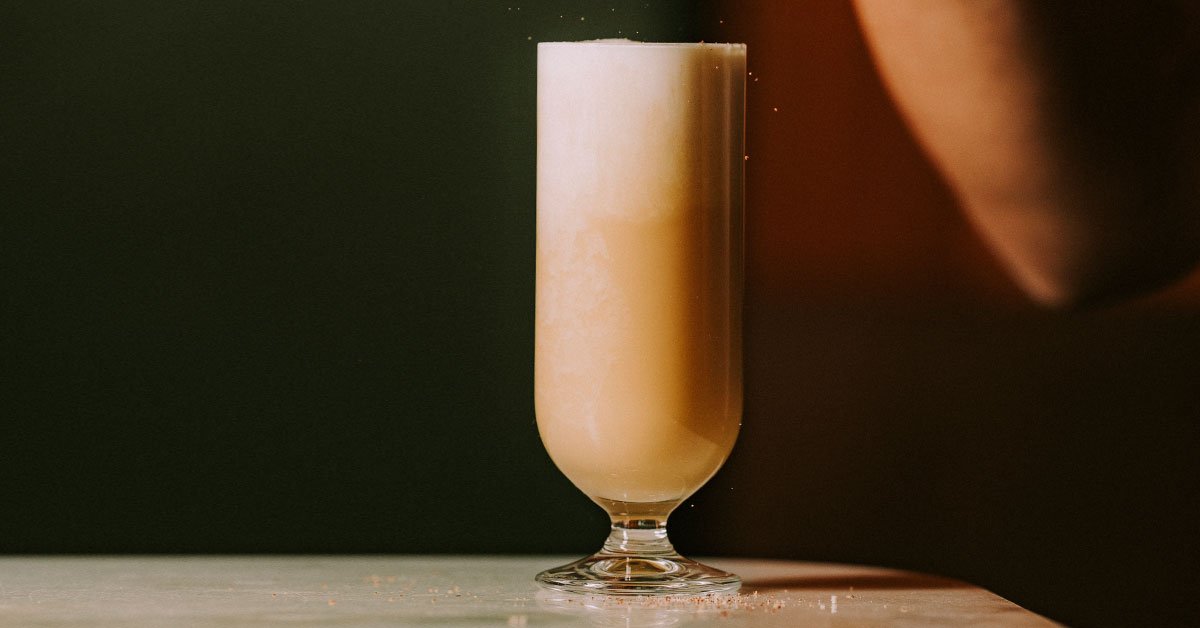

Like many Italian cocktails, the Bombardino begins with a simple story that’s been repeated often enough to have become legend.
Some of the details are murky, but almost everyone agrees that the drink was invented in the 1970s in Livigno, a ski town bordering Switzerland, by a lift manager and lodge owner named Aldo Del Bò. One day, the story goes, a group of skiers staggered into his rifugio (mountain lodge) and asked for something to warm them up. Del Bò had been experimenting with a new concoction in his spare time, and so his manager, Erich Ciapponi, went behind the bar and made it for them.
Ciapponi heated up some Vov—an Italian egg-yolk liqueur akin to zabaglione, already popular among the ski crowd in the area—spiked it with Scotch, and then topped the mixture with cold whipped cream. One of the first to taste the new house drink reportedly exclaimed, “È una bomba!” (“It’s a bomb!”), because of its explosive strength.
The name stuck. And thus, the Bombardino—Italy’s ski-season staple—was born.
When the snow starts to stick each year, Italians make for the mountains. As they trade the damp winter gloom of cities like Milan and Turin for long days on the slopes, aperitivo becomes après-ski. The drinks, for the most part, are the same as in the cities—beer, wine and spritzes—except for this one winter-only outlier.
The first time I tried a Bombardino was at Rifugio Palù in the Valtellina region. Getting there required a two-mile uphill hike through snow. I was cold and exhausted and the lodge was in full après mode by the time I arrived. Skiers, snowboarders and hikers had stripped off top layers and packed the terrace to sip the drink from paper cups, so I opted for the same. The Bombardino was a quick hit of boozy, high-calorie energy.
To make the Bombardino, bartenders today typically pour Vov (a Marsala-based egg liqueur made in Padua since 1845) or Zabov (a brandy-laced competitor made in Ferrara since 1946) into carafes with brandy—a twist from the original that quickly became the norm as the drink spread across the Alps. They heat the mixture with the steam wand of an espresso machine and finish it with a thick topping of canned whipped cream.
For decades, that recipe has barely changed, though there are variations, like a Calimero, which incorporates espresso, or a Pirata or Scozzese, which replace brandy with rum and Scotch, respectively. And some have put their own spins on it, like Mirko Ferrari, bar manager at Ancora Cortina, a stylish and newly renovated 200-year-old resort in Cortina d’Ampezzo, host of the 2026 Olympics. The hotel offers both the classic and a version layered with biscuit-infused brandy, aged rum, raspberry sugar and white chocolate-flavored milk.
To find one of the more distinctive versions, though, you have to go to Lisbon. Every December, Basque-born Alf del Portillo and Italian business partner Marta Premoli serve a Bilbao-meets-Milan spin on the Bombardino at their bar in Baixa, Quattro Teste.
Del Portillo says he didn’t encounter the drink in the Alps. He first came across it years ago in Bilbao, when an Italian regular walked into his bar with a bottle of Vov and made one for him. “It warmed me up and gave me a sugar rush,” he says. “But I understood why these drinks are best enjoyed in the cold mountains.”
Del Portillo and Premoli make their own Vov liqueur using less sugar, built with dry Marsala, sherry and vermouth. To that, they add a peaty Scotch, cold salted cream and grated tonka bean for nuttiness and contrast. “We try to be cultural ambassadors of the Basque country and Italy,” del Portillo says. “This drink fits perfectly with what we do.”