

Restaurant Business image generated by AI
TGI Fridays spent 2025 working to get out from under bankruptcy. It cut its debt and closed underperforming locations. CEO Ray Blanchette now has plans to return the chain to prominence, taking the brand into new global markets with traditional and nontraditional units.
That’s if the economy lets that happen. “You know, it’d be nice to have less uncertainty,” he said. “It’d be nice to see more confidence in the middle class, right? Which is where casual-dining pretty much lives.
“I’m generally bullish but, you know, it’s hard to watch the news these days.”
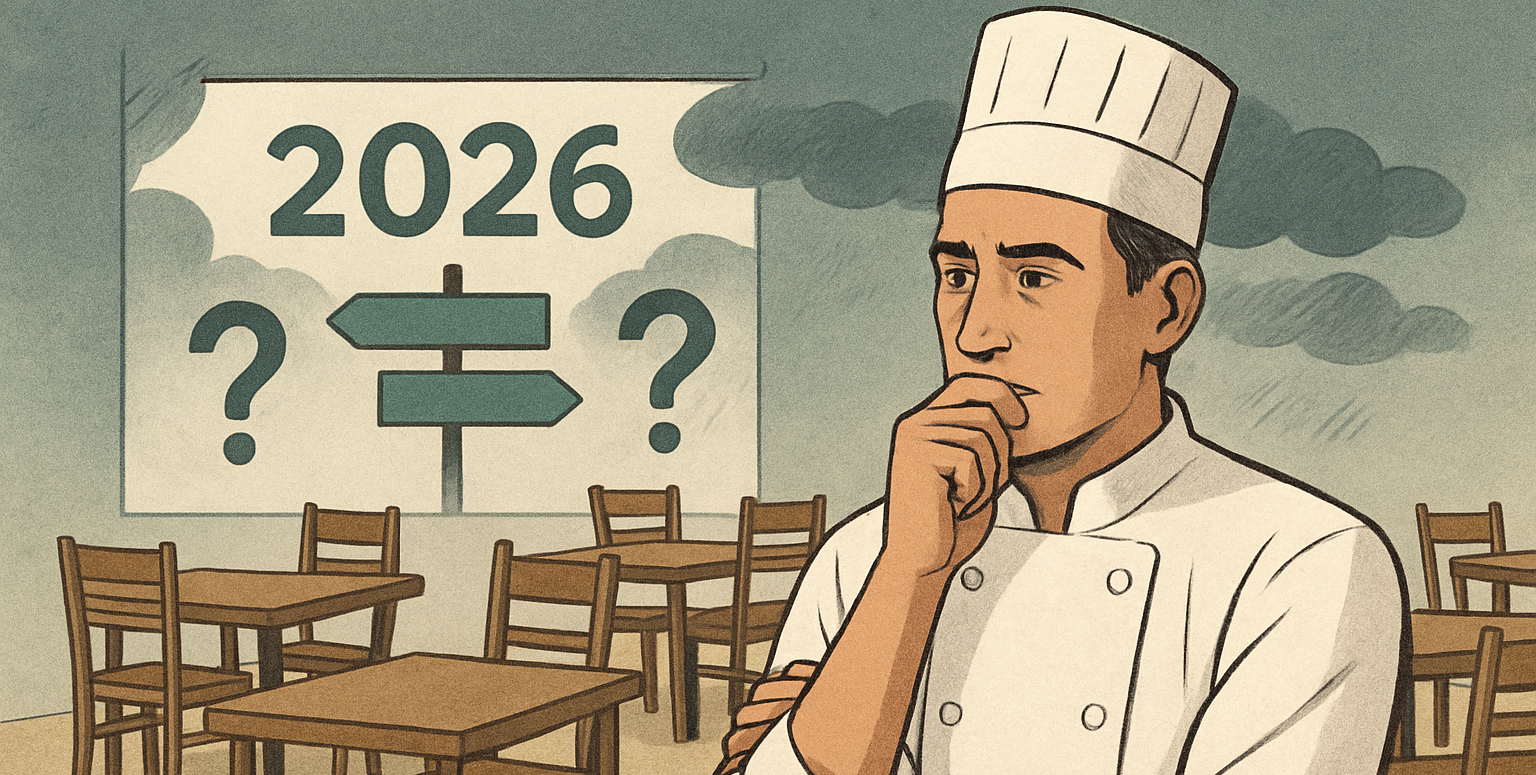
Welcome to the restaurant industry at the outset of 2026. Restaurant operators are hopeful, or even bullish, on their own plans, believing they can emerge from a tough few years. But if there’s one thing that period has taught them, it’s that anything can happen and, frankly, it probably will.
Prognosticators believe that this will be a better year than 2025, if for no other reason than because comparisons will be easier, at least in the early part of the year. Tax law changes could provide a boost this spring. The stock market remains strong, providing an underpinning of strength that has kept overall consumer spending surprisingly robust.
Yet plenty of data suggests that the benefits won’t be felt evenly across industry sectors. Wealthier consumers will likely carry the load while lower-income consumers cut back. And then there is the volatility coming out of Washington, D.C., which can change everything with the publication of one social media post.
This story is based on a compilation of comments in interviews with executives and presentations at the ICR Conference this week, as well as the 2026 Foodservice planning Program from Restaurant Business sister company Technomic.
Predictions: Slow growth
Restaurants expected 2025 to be better than a bankruptcy-riddled 2024 as the election promised more certainty. That did not happen.
Bad weather and fires in California hammered restaurant sales. Tariff talk shocked consumer confidence. A spring and summer of relative calm was then followed by a brutal, weeks-long government shutdown.
A growing number of restaurant chains, including heretofore untouchable Chipotle, reported weak sales. Valuations plunged on Wall Street, with the typical restaurant stock down 16% during a year in which the market rose by 16%. Restaurant industry traffic, for both full-service and limited-service chains, spent most of the year underwater.
Restaurant sales increased 3% last year, but adjusted for inflation they declined 0.7%, according to Technomic.
The data firm expects improvement this year, projecting 4.3% sales growth, or 1% when adjusted for inflation. “The good news is it’s a return to real growth,” said Technomic Managing Principal Joe Pawlak. “Although it may be just 1%, it nonetheless is a return to real growth for the industry.”
Fitch Ratings expects spending at restaurants to grow in the “low single digits” this year, but traffic to remain “relatively flattish.”
Restaurants will have limited pricing power, Fitch restaurant analyst Luis Rivas said at the ICR Conference. “The cumulative effect of inflation over the past five years, with 30-plus percent accumulated inflation, has made consumers to be more price sensitive,” he said.
A bifurcated economy
The U.S. economy is expected to grow 2.1% this year, according to consensus estimates, though Goldman Sachs economists expect actual growth to outpace that figure. They have also cut the probability of a recession this year to 20%.
One big reason? Tax law changes under the Big Beautiful Bill are expected to increase the size of tax returns this spring. Coming a year after tariffs led consumers to cut spending, that could provide a boost for restaurants—which often get a few extra visits when consumers get extra cash in their pocket.
Yet the benefits of that tax law are weighted more heavily toward upper-income consumers that have been spending freely in recent years and largely carrying the economy. Arjun Chakravarti, an economist and managing partner with the consulting firm Cogknition Analytics, pointed out that a high-income earner who takes a $10,000 vacation offsets $500 spending cuts apiece by 20 lower-income earners.
Lower-income earners may spend their tax refunds, but higher-income earners are more likely to save the funds or invest them.
What’s more, lower-income earners will be hurt by other changes, such as cuts to Medicaid and SNAP, and disproportionately hurt by the end of Affordable Care Act (ACA) healthcare premium subsidies. Other issues are also eating into consumers’ earning power, such as rising home insurance premiums that are costing homeowners more money and are driving up rent costs. All that could offset potential tax benefits this year.
“The numbers can be distributed in fairly small ways for lower-income individuals, especially when you net away cuts in things like Medicaid and SNAP and ACA coverage, etc., on the lower end,” Chakravarti said at the Technomic event.
All of which means it might be another year of bifurcated spending. Some restaurant chains will do well. Others will not. And the big determining factor will be the customer base’s income level.
“Not everything is spread out equally,” Pawlak said. “There are winners and losers in all different segments and markets across the industry.”
Executive and operator views
Restaurant operators have experienced that for the past two years. “It’s no secret, it continues to be challenging,” Liz Williams, CEO of El Pollo Loco, said at the conference this week. “The consumer is under a lot of pressure, and I think we’ve seen it in 16 different ways.”
Restaurant operators at the conference expressed optimism in their plans, which is typical for such events, despite the economic challenges. Williams, for instance, said that the chicken chain she runs will make it through whatever challenge the company faces this year.
“We feel like we’re very well positioned,” Williams said. “We fit in that intersection between quick service and fast casual. We’re very affordable.”
Several operators said they believe the economic data is on the side of the restaurant industry. Last year was tough, after all, and there are plenty of reasons to expect things will change this time around.
“I’m very optimistic, for the entire industry, certainly for us,” said Steve Kislow, CEO of Firebirds. “There were so many uncertainties in 2025, and I think there’s a little bit more certainty now. I think the consumer is getting more comfortable, whether it’s with the administration, with the fact that tariffs didn’t ruin the world.”
Barry McGowan, CEO of the Brazilian steakhouse chain Fogo de Chao, suggested that some of the economic data should lead to improved sales.
“Every indicator on consumer discretionary income is moving in the right direction,” he said, noting that gas prices are coming down, wages are rising faster than inflation and tax returns will be bigger.
But last year was expected to be better, too, and turned out to be the opposite, which has other industry observers concerned.
“You know, 2025 has been tough, and I don’t think 2026 is going to be easier as well,” said Benny Tadele, president of NCR Voyix. “Talent is very tough to come by. Wages are going up. So even if inflation of food costs is coming down, it is still a very hard environment for restaurants to manage.”
And yet consumers are still focused heavily on price after years of inflation. Restaurant chains introduced several new value offers in early January despite a price war that has been ongoing for well over 18 months now.
Noah Glass, CEO and founder of Olo, expects more of that this year, which will be a challenge for many restaurant brands, especially franchise systems. “Deep discounts that reset the value equation for the guests and aren’t really sustainable for franchisees,” he said. “That’s problematic.”