

The kitchen at Chef’s Pencil wasn’t filled with the scent of searing scallops or reduced demi-glace this week. Instead, it smelled of old yearbooks, digital archives, and the quiet hum of data processing. Our team set out to answer one of the oldest debates in the gastronomic world: Do you need a degree to win a Michelin star?
To find the answer, our team analyzed the educational backgrounds of 278 Michelin-starred chefs currently leading some of the most prestigious kitchens in the United States.
Key Findings
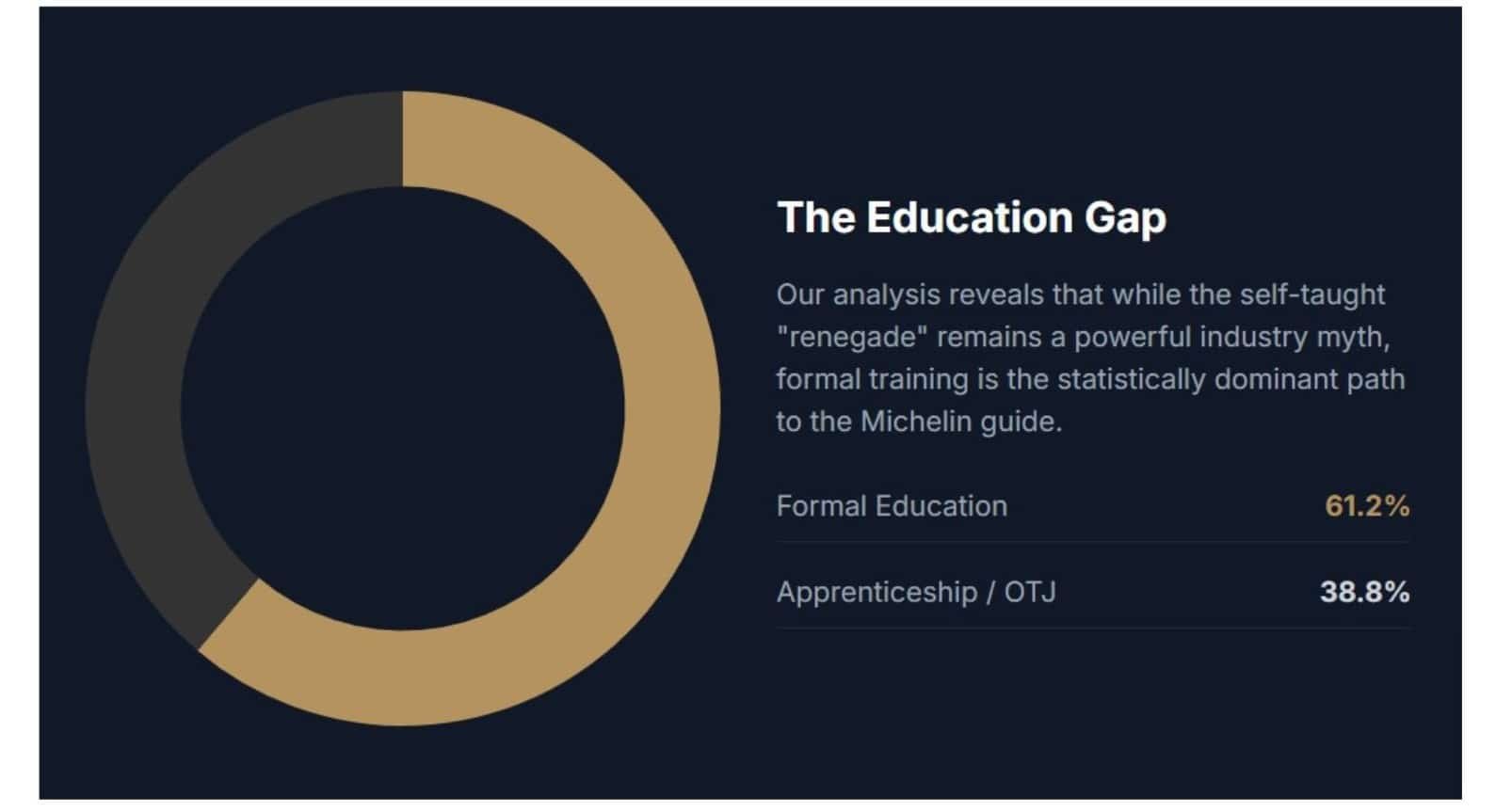
61% of U.S. Michelin-starred chefs attended culinary school
39% built their careers without formal culinary education
The Culinary Institute of America produced the most Michelin chefs (14%)
Le Cordon Bleu ranked second (8.3%)
Private culinary schools dominate Michelin chef backgrounds
Importantly, the scope of this analysis is more geographically representative than ever before. The Michelin Guide has significantly expanded its U.S. coverage in recent years. What once focused primarily on New York, Washington, D.C., Chicago, and California now also includes Atlanta, Miami, Dallas, Houston, Philadelphia, Nashville, New Orleans, San Antonio, and Denver.
As a result, our findings reflect not only the traditional fine dining strongholds but a broader cross-section of America’s evolving culinary landscape, making the conclusions more representative not just of Michelin-starred restaurants, but of the contemporary U.S. fine dining scene as a whole. While the mythology of the self-taught chef remains powerful, the numbers show that nearly two-thirds of America’s Michelin kitchens are led by chefs who spent time in structured culinary programs.
How Many Michelin-Starred Chefs Went to Culinary School?
Our analysis of 278 Michelin-starred chefs leading restaurants in the United States found that a clear majority have some form of formal culinary education.
61% attended culinary school or a formal hospitality program that included culinary training
39% did not attend culinary school, building their careers through apprenticeships and on-the-job experience instead

In total, 170 chefs in the dataset completed formal culinary education, while 108 chefs followed alternative training paths.
This finding suggests that while culinary school is a common route among Michelin-starred chefs, it is far from the only path to success in fine dining. Many chefs develop their skills through years of kitchen experience, mentorship, and apprenticeships rather than formal academic programs.
At the same time, the data shows that certain culinary schools appear repeatedly in the educational backgrounds of Michelin-starred chefs, particularly well-established private institutions and internationally recognized culinary academies.
The Apprenticeship Path: 38.8% Without Culinary School
More than one-third of Michelin-starred chefs in the U.S. built their careers without formal culinary education.
One compelling example is Brandon Jew, chef-owner of the one-Michelin-star Mister Jiu’s in San Francisco’s Chinatown.
Brandon did not attend culinary school. After studying biology at UC Irvine, he fell into cooking while working restaurant jobs. Culinary school felt financially out of reach, so he pursued alternative ways to develop his craft. Other cooks suggested the apprenticeship path, so he traveled to Italy in 2001 to apprentice in Piedmont and Bologna.
Immersing himself in the kitchens of northern Italy provided more than technical training as it offered a deep understanding of regional identity, tradition, and culinary culture. Through hands-on apprenticeships in Piedmont and Bologna, he experienced how food reflects history, geography, and community.
Apprenticeships often provide what formal classrooms cannot: daily exposure to living culinary traditions, close mentorship, and a nuanced understanding of how cuisine evolves within its cultural context.
The Top Culinary Schools Behind America’s Michelin Stars
Our data shows that certain culinary schools appear repeatedly in the educational backgrounds of Michelin-starred chefs.
1. Culinary Institute of America (CIA) — 14% of U.S. Michelin Chefs
The Culinary Institute of America was the most represented school in the dataset, accounting for 14% of Michelin-starred chefs in the U.S. Widely regarded as the country’s most prestigious culinary school, the CIA has trained generations of chefs through its rigorous, technique-focused programs. Its alumni include chefs such as Grant Achatz (Alinea, Next), Daeik Kim (Jungsik) and Richard Lee (Saison), reflecting the school’s outsized influence on fine dining in America.
2. Le Cordon Bleu — 8.3%
Founded in Paris in 1895, Le Cordon Bleu is one of the most famous culinary institutions in the world and a global standard-bearer for classical French technique. The study found 8.3% of U.S. Michelin-starred chefs among its alumni, including chefs trained at campuses in Europe as well as the former North American Le Cordon Bleu schools. Notable alumni include Ryan Ratino (Bresca, Jônt), Nancy Silverton (Osteria Mozza), and Ron Hsu (Lazy Betty).
3. Johnson & Wales University — 5.0%
Johnson & Wales University ranked third, producing 5% of Michelin-starred chefs in the dataset. Known for combining culinary training with hospitality and business education, the school has built a strong reputation in professional kitchen leadership. Alumni include Karen Urie-Shields (Smyth), Jenner Tomaska (Esmé), and Corey Jamison (Rooster & Owl).
4. Institute of Culinary Education (ICE) — 4.7%
New York’s Institute of Culinary Education followed closely with 4.7% of Michelin-starred chefs. ICE has become one of the leading culinary schools in the United States, particularly after absorbing the French Culinary Institute and the International Culinary Center, two historically influential programs. Notable alumni include Luciana Giangrandi (Boia De), Joe Hou (Angler SF), and Samuel Clonts (63 Clinton).
5. (Tie) Ferrandi Paris — 1.4%
Often called the “Harvard of gastronomy,” FERRANDI Paris is one of France’s most prestigious culinary schools and a major training ground for chefs specializing in classical French cuisine. Though smaller in representation in the U.S. dataset, its global influence remains significant. Alumni include chefs such as Michael Anthony (Gramercy Tavern) and Christophe De Lellis (Mamani).
5. (Tie) Tsuji Culinary Institute — 1.4%
Founded in Osaka, Tsuji Culinary Institute is among Japan’s most respected culinary schools, known for its rigorous technical training and strong focus on both Japanese and French cuisine. The institute’s alumni include Yuu Shimano (Restaurant Yuu) and Isao Yamada (Yamada), chefs who have gone on to lead Michelin-recognized kitchens internationally.
Note: Alumni counts include chefs who studied at the institution’s main campus, international branches, or legacy schools that later merged into the institution (for example, the French Culinary Institute and International Culinary Center within ICE, or former Le Cordon Bleu campuses in North America).

Other Top Schools That Appeared in the Research
Several other culinary institutions appeared multiple times in the dataset:
Escola d’Hostaleria Hofmann, Barcelona, Spain — 2 chefs
L’Académie de Cuisine — 2 chefs
Dozens of additional local and international institutions appeared in the dataset, along with a small number of community college culinary programs.
Community Colleges Are Rare Among Michelin Chefs
One notable pattern in the data is the limited representation of community college culinary programs. While these programs graduate thousands of students each year and offer significantly lower tuition, few chefs leading Michelin-starred kitchens appear to have followed that path.
Of the chefs in our study who attended culinary school in the United States, most graduated from private culinary institutions. In addition to the top private culinary schools listed above, many others attended smaller (or newer) private culinary schools such as Escoffier, Chicago’s French Pastry School, and the now-defunct L’Academie de Cuisine and Natural Gourmet Institute.
We do not suggest that private institutions are a requirement for success. It simply reflects what the current numbers show: private and international culinary schools appear more frequently in the educational backgrounds of Michelin-starred chefs.
Attending a private culinary school can provide valuable training, industry exposure, and networking opportunities. However, prospective students should carefully consider the financial commitment. Tuition at some private culinary schools can exceed tens of thousands of dollars, while entry-level positions in professional kitchens often pay modest wages. Graduates who rely on student loans may therefore carry substantial debt into the early years of their careers, when wages are typically low and advancement often depends on gaining experience rather than formal credentials.
Is Culinary School Essential? Chefs Weigh In
To complement the data, Chef’s Pencil also asked chefs directly about the role formal education played in their careers. One such voice is Chef Yuu Shimano of Michelin-starred Restaurant Yuu in New York. When asked:
“Your journey began at the Tsuji Culinary Institute in Osaka. Looking back, how important was culinary school in shaping your career, and do you believe formal training is essential for young chefs today?”
Chef Shimano reflected on the importance of foundation over format:
“Attending the Tsuji Culinary Institute, both in Japan and in France, gave me the foundation of classic technique and discipline that still supports my cooking today. For young chefs, I believe formal training is not the only path, but having a strong foundation—whether in a school or through a structured apprenticeship—is essential.” – Chef Yuu Shimano, Michelin-starred Restaurant Yuu, New York
Chef Daeik Kim of Michelin-starred Jungsik in New York echoed a similar sentiment about the value of refining one’s fundamentals:
“I attended the Culinary Institute of America after working in professional kitchens in Korea for about a decade. For me, it was an opportunity to revisit the foundations and expand my perspective. Ultimately, education is only as meaningful as the effort you put into it.”
— Chef Daeik Kim, Michelin-starred Jungsik, New York
And from the pastry world, Chef Eric Wolitzky, Executive Pastry Chef for Fifth Group Restaurants in Atlanta, offered a pragmatic perspective:
“If you’re a pastry nerd like me, and you fantasize about learning as many techniques as possible, then culinary school can be a dream. I made friends for life there. But a formal education won’t necessarily get you a job. What matters more is working under the right chefs who are willing to teach and mentor.”
— Chef Eric Wolitzky, Executive Pastry Chef, Fifth Group Restaurants
Chef Ron Hsu, chef-owner of Lazy Betty in Atlanta and a graduate of Le Cordon Bleu, offered a candid perspective on the value of formal culinary education compared with real kitchen experience:
“It is not essential. In fact, I’d hire someone with one year of experience over someone with one year of culinary school. I always tell someone interested in going to culinary school to do it if they have the resources to do it. It gives aspiring young chefs exposure to food that otherwise may take years to get in the industry.” Chef Ron Hsu, Chef-Owner, Lazy Betty, Atlanta
Together, these voices reinforce what the data suggests. While 61% of Michelin-starred chefs in the U.S. attended culinary school, the remaining 39% prove that there is no single path to excellence. What matters most is not only where you train, but how deeply you commit to mastering the craft and the opportunities for mentorship, guidance, and professional connections that help shape a chef’s career along the way.
Methodology
This research was conducted by the editorial team at Chef’s Pencil, which regularly publishes data-driven analysis of global culinary trends.
Chef’s Pencil analyzed the educational backgrounds of 278 chefs currently leading Michelin-starred restaurants across the United States, covering restaurants awarded one, two, or three Michelin stars in all U.S. cities included in the Michelin Guide. The dataset primarily includes executive chefs and chef-owners, although a small number of executive pastry chefs leading Michelin-starred pastry programs were also included.
The research was conducted manually using publicly available information, including:
LinkedIn profiles
Official restaurant “About” pages
Chef biographies published on restaurant websites
Social media profiles
News interviews and feature articles
In many cases, chefs explicitly stated the culinary school they attended or noted that they did not pursue formal culinary education. However, there were instances where biographies mentioned formal culinary training without naming a specific institution. This was particularly common for international culinary schools, but also occurred with some U.S.-based programs.
For the purposes of this analysis, we also included hospitality and culinary management programs where chefs received formal training that included culinary coursework, even if the primary focus of the program was broader hospitality education rather than strictly culinary arts.
It is important to note that manual research of this scale is inherently subject to limitations. While we made every effort to verify information across multiple sources where possible, minor inaccuracies may occur. We did not independently confirm educational details directly with every chef included in the dataset.
This analysis reflects the best available publicly accessible information at the time of publication.
Are you a Michelin-starred chef with a different story? Contact our research team at [email protected].